Pay in installments of $5.56 with
 ,
,
 and
and

Shipping Estimate
USA
- USA
- CAN
- USA
- CAN
Ships within 48 hours · Estimated delivery Aug 9 - Aug 14
 Promo Codes Available:
For Your Every Summer RSVP, with Code: SUMMER15
Description
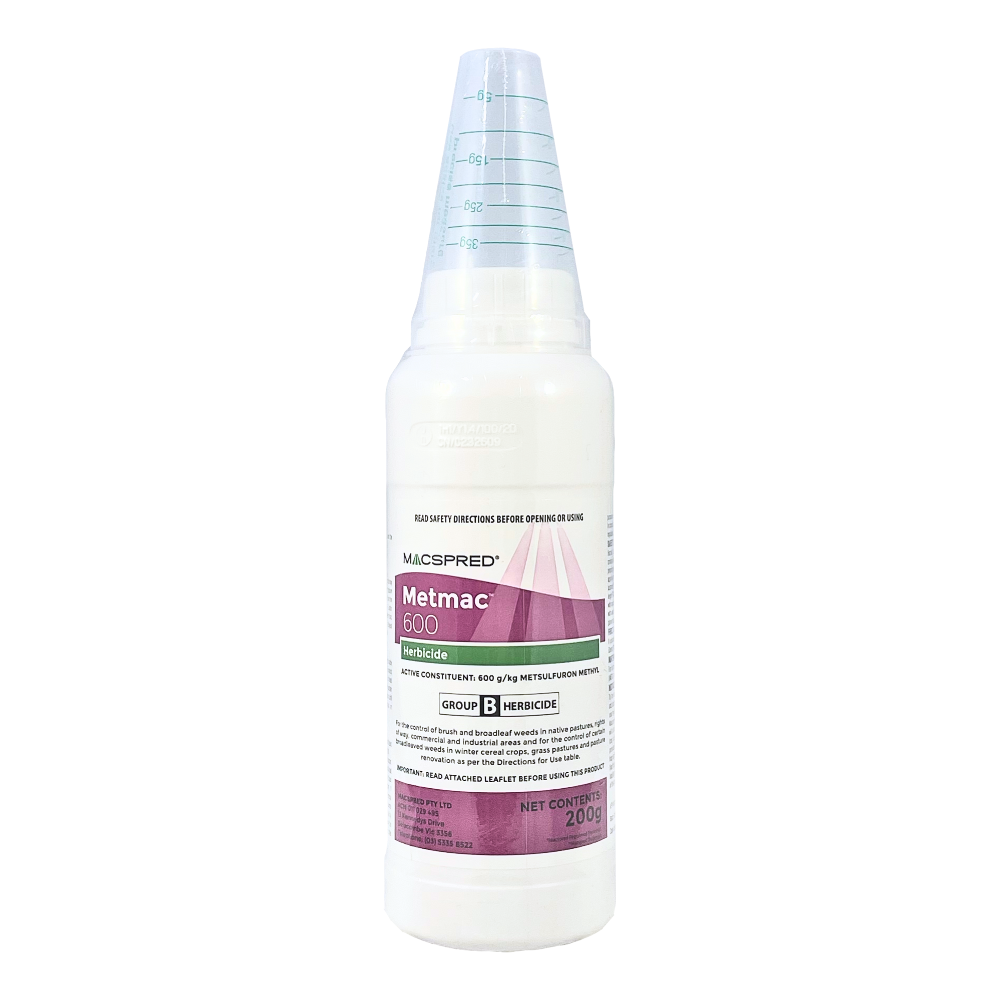
briar herbicide Macspred Metmac 600 WG Metsulfuron methylGroup 2 Herbicide The Macspred Metmac 600WG Herbicide is a Group 2 Herbicide with 600 g kg Metsulfuron Methyl as its active ingredient. It is used for controlling brush and broadleaf weeds in native pastures, rights of way, commercial and industrial areas, as well as in winter cereal crops, grass pastures, and pasture renovation. Key Features: Broad spectrum Use Metmac alone or in a mixture controls a broad spectrum of different species of brush,
Group 2 Herbicide
The Macspred Metmac 600WG Herbicide is a Group 2 Herbicide with 600 g/kg Metsulfuron Methyl as its active ingredient. It is used for controlling brush and broadleaf weeds in native pastures, rights of way, commercial and industrial areas, as well as in winter cereal crops, grass pastures, and pasture renovation.
Key Features:
-
Broad spectrum - Use Metmac alone or in a mixture controls a broad spectrum of different species of brush, broadleaf and bulbous weeds. Mixed infestations of hard to control woody weeds, including Lantana, Gorse, Bracken, Tree-of-Heaven, St John’s Wort and Blackberry, Metmac can be sprayed in one pass. Metmac also controls nuisance pasture weeds, including Doublegee, Erodium, Sorrel, Onion grass and Paterson’s Curse (refer to label).
-
Dry flowable product (1kg packs) - Metmac is easy to transport, store, handle, measure and mix.
-
Low application rate - Metmac is highly active, meaning less chemical is used per hectare.
-
Non hormonal, non volatile - Metmac can be safely applied near horticultural crops providing adequate measures are taken to avoid physical spray drift.
-
Unscheduled poison - Metmac has a relatively low toxicity and is classed as an unscheduled poison. When used as directed, it does not create any hazards to humans, fish or animals.
-
No withholding period for grazing - the half-life of residues on foliage treated with Metmac is less than one day; after 3 days, essentially no residues can be detected. Livestock DO NOT have to be removed from the paddock during spraying or immediately afterwards. Metmac does not accumulate in animals or the environment: it is readily metabolized in and eliminated from animals via natural processes.
-
Biodegradable - Metmac degrades rapidly in the environment. Metmac degrades readily in the soil and is not considered a persistent herbicide. Metmac exhibits a half life of about 4 weeks when it is used at normal rates.
-
Compatible with other selective and knockdown herbicides and insecticides - Metmac is compatible with the non-selective herbicide, glyphosate, and the pasture herbicides, 2,4-D amine, MCPA amine, clopyralid and dicamba for even broader spectrum control when cleaning pastures. Metmac is also compatible with the commonly used pasture insecticides chlorpyrifos and omethoate.
-
Safe to the environment - Metmac is very low in toxicity to mammals, birds, fish and insects.
Weeds Controlled:
Broadleaf and Herbaceous Weeds
-
African Turnip Weed (Sisymbrium thellungii)
-
Amsinckia / Yellow Burweed (Amsinckia spp.)
-
Ball Mustard (Neslia paniculata)
-
Boggabri Weed / Dwarf Amaranth (Amaranthus macrocarpus)
-
Calomba Daisy (Pentzia suffruticosa)
-
Cape Tulip (Homeria spp.)
-
Charlock (Sinapis arvensis)
-
Chickweed (Stellaria media)
-
Chicory (Cichorium intybus)
-
Clovers (Trifolium spp.)
-
Common Sowthistle (Sonchus oleraceus)
-
Cutleaf Mignonette (Reseda lutea)
-
Deadnettle (Lamium amplexicaule)
-
Denseflower Fumitory (Fumaria densiflora)
-
Dock (Broadleaf) (Rumex obtusifolius)
-
Faba Beans (Volunteer) (Vicia faba)
-
Field Peas (Volunteer) (Pisum sativum)
-
Hare’s Ear / Treacle Mustard (Conringia orientalis)
-
Hogweed / Wireweed (Polygonum aviculare)
-
Indian Hedge Mustard (Sisymbrium orientale)
-
Lincoln Weed (Diplotaxis tenuifolia)
-
Lupins (Volunteer) (Lupinus albus)
-
Mallee Catchfly (Silene apetala)
-
Medic (Volunteer Annual Medics) (Medicago spp.)
-
New Zealand Spinach (Tetragonia tetragonoides)
-
Parthenium Weed (Parthenium hysterophorus)
-
Paterson’s Curse / Salvation Jane (Echium plantagineum)
-
Prickly Lettuce (Lactuca serriola)
-
Red Pigweed (Portulaca oleracea)
-
Rough Poppy (Papaver hybridium)
-
Saltbush (Atriplex muelleri)
-
Shepherd’s Purse (Capsella bursa-pastoris)
-
Skeleton Weed (Suppression only) (Chondrilla juncea)
-
Slender Celery (Apium leptophyllum)
-
Smallflower Fumitory (Fumaria parviflora)
-
Sorrel (Rumex acetosella)
-
Soursob (Oxalis pes-caprae)
-
Spiny Emex / Doublegee / Threecornered Jack (Emex australis)
-
Stagger Weed (Stachys arvensis)
-
Storksbill / Wild Geranium (Erodium spp.)
-
Turnip Weed (Rapistrum rugosum)
-
Volunteer Sunflower (Helianthus annuus)
-
Wild / Crow Garlic (Allium vineale)
-
Wild Turnip (Brassica tournefortii)
Woody and Tough Weeds
-
Alligator Weed (Alternanthera philoxeroides)
-
Apple Box (Angophora floribunda)
-
Australian Blackthorn (Bursaria spinosa)
-
Bellyache Bush (Jatropha gossypifolia)
-
Blackberry (Rubus spp.)
-
Bitou Bush / Boneseed (Chrysanthemoides monilifera)
-
Bridal Creeper (Asparagus asparagoides)
-
Common Bracken (Pteridium esculentum)
-
Crofton Weed (Ageratina adenophora)
-
Darling Pea (Swainsona spp.)
-
Fennel (Foeniculum vulgare)
-
Golden Dodder (Cuscuta australis)
-
Great Mullein (Verbascum thapsus)
-
Harrisia Cactus (Eriocereus spp.)
-
Hawthorn (Crataegus laevigata)
-
Inkweed (Phytolacca octandra)
-
Japanese Sunflower (Tithonia diversifolia)
-
Kangaroo Thorn (Acacia paradoxa)
-
Lantana (Lantana camara)
-
Messmate Stringybark (Eucalyptus obliqua)
-
Mistflower / Creeping Crofton (Eupatorium riparium)
-
Narrowleaf Peppermint (Eucalyptus radiata)
-
Noogoora Burr (Xanthium pungens)
-
Privet (Ligustrum spp.)
-
Ragwort (Senecio jacobaea)
-
Rubber Vine (Cryptostegia grandiflora)
-
Smartweed (Polygonum spp.)
-
Sweet Briar (Rosa rubiginosa)
-
Tree of Heaven (Ailanthus altissima)
-
Wait-a-While (Caesalpinia decapelata)
-
Yellow Box (Eucalyptus melliodora)
Shipping Notes
- Free Standard Shipping on $100+ Orders to the USA.
- Except Preorder products are shipped in 48 hours.
- Delivery to the USA:
- Standard Shipping : 3-10 business days
- If time is of the essence, please consider selecting expedited delivery for faster service.
Exchange/Return Notes
- We offer a 30-day return/exchange service after receiving.
- Final sale items are not eligible for returns or exchanges.
- To process your return/exchange, please contact us at [email protected]
- Please click here for more details>>> Return & Exchange Policy