SKU: 15929557454
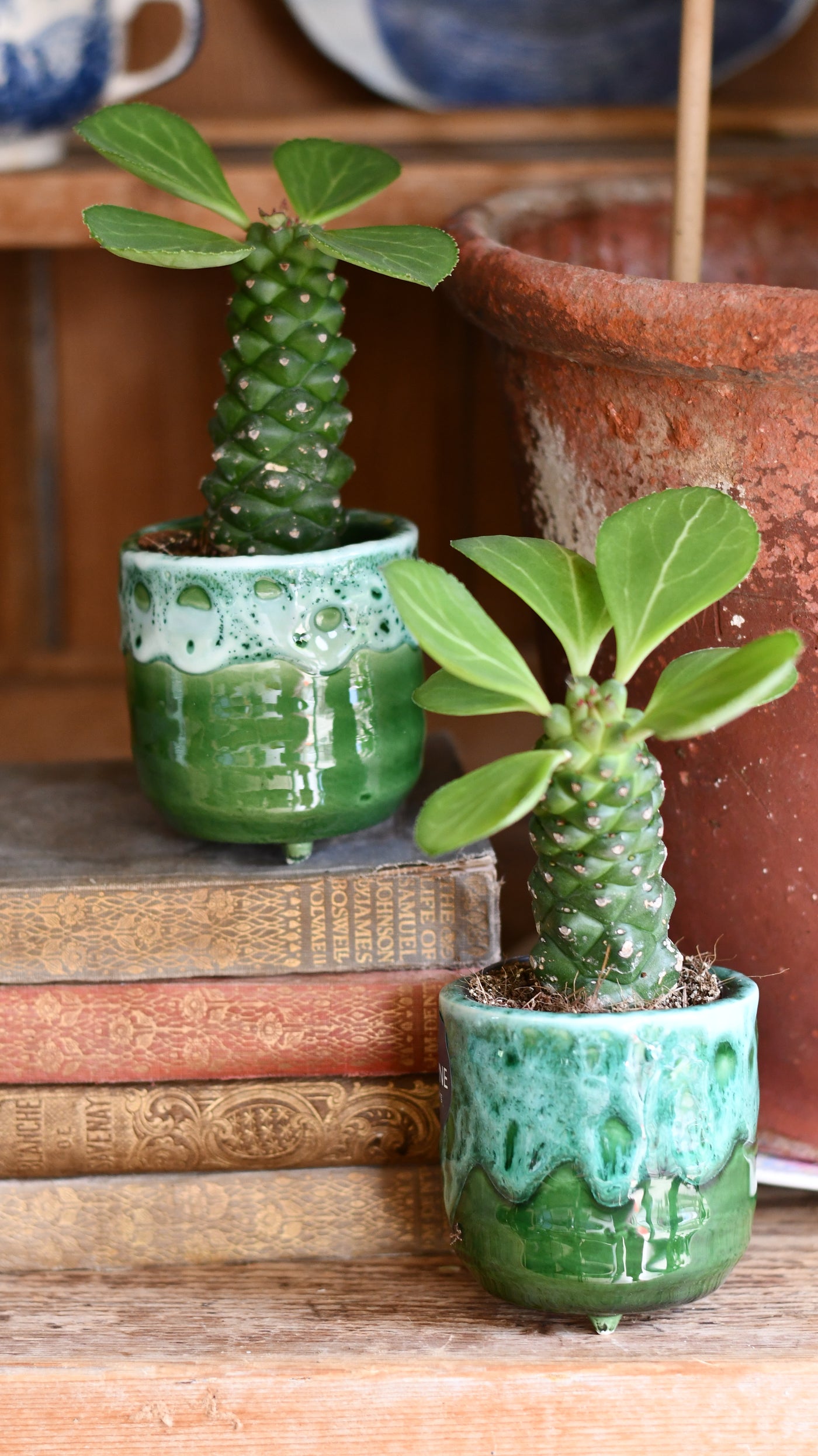
mini palm tree succulent

mini palm tree succulent Euphorbia ritchiei | Rare Cactus

Sale price$22.87 Regular price$25.41
Save 10%

Pay in installments of $6.35 with ShopPay, AfterPay and Klarna

Shipping Estimate
USA
  • USA
  • CAN

Ships within 48 hours · Estimated delivery Aug 3 - Aug 8

Promo Codes Available:

For Your Every Summer RSVP, with Code: SUMMER15

Description

mini palm tree succulent Euphorbia ritchiei | Rare CactusEuphorbia ritchiei is a compact and sculptural succulent prized for its chunky, ridged stems and unique, spiral growth habit. Native to Kenya, this rare Euphorbia adds striking form and texture to small spaces, making it an ideal choice for shelves, desktops, or windowsills. If you love unusual, architectural plants that are easy to care for, Euphorbia ritchiei is a fantastic addition to your collection. Unlike many Euphorbias with a spiny appearance,

Euphorbia ritchiei is a compact and sculptural succulent prized for its chunky, ridged stems and unique, spiral growth habit. Native to Kenya, this rare Euphorbia adds striking form and texture to small spaces, making it an ideal choice for shelves, desktops, or windowsills. If you love unusual, architectural plants that are easy to care for, Euphorbia ritchiei is a fantastic addition to your collection.

Unlike many Euphorbias with a spiny appearance, Euphorbia ritchiei has a smoother, more ridged texture and produces small offsets over time, gradually forming a low, spreading clump. This is a true collector’s piece — a beautiful, slow-growing plant that thrives on minimal care and makes a big impact despite its modest size.

Size
Supplied in a 6cm nursery pot
Approximate height: 10cm

Native Habitat and Growth Habit
Euphorbia ritchiei is native to East Africa, particularly Kenya, where it grows in arid, rocky areas. It has adapted to survive in tough environments, storing water in its thick, succulent stems. Indoors, it remains compact and tidy, gradually producing offsets and developing into a cluster of ridged, sculptural columns.

Care Requirements for Euphorbia ritchiei

Water:
Water sparingly. Allow the soil to fully dry out between waterings. Euphorbia ritchiei is drought-tolerant and prefers neglect to overwatering.

Temperature & Humidity:
Thrives in average indoor temperatures between 18–24°C. Low humidity is not a problem.

Soil:
Use a gritty, well-draining cactus or succulent mix. You can also amend houseplant compost with sand or perlite.

Feeding:
Feed once a month during spring and summer with a diluted cactus fertiliser or our Organic Tropical Plant Food, which supports gentle, sustained growth.

Light:
Place Euphorbia ritchiei in bright, indirect light or direct sun. A sunny windowsill is ideal. The more light it receives, the more compact and healthy the growth.

Seasonal Leaf Drop – What to Expect:
Euphorbia ritchiei occasionally produces small leaves near the top of its stems, especially in spring and summer. These leaves are temporary and will naturally drop off as the plant matures or when the seasons change — this is completely normal and part of how the plant conserves moisture. It’s not a sign of distress or poor health. In its native environment, the plant sheds its leaves to survive hot, dry spells. Indoors, it does the same — think of the leaves as seasonal visitors rather than permanent features. This adaptation is what makes Euphorbia ritchiei such a tough, resilient choice for low-maintenance plant lovers.

Why Choose Euphorbia ritchiei?
  • A rare and unusual succulent with sculptural appeal

  • Easy to grow and very low maintenance

  • Perfect for small spaces and bright windowsills

  • Slow-growing and great for collectors of unique Euphorbias

  • Requires minimal watering and no fuss

Styling Ideas
Display Euphorbia ritchiei in a shallow clay or stone pot to accentuate its architectural form. It pairs beautifully with other succulents and cacti in mixed arrangements, or as a standalone specimen in a minimalist setup. Ideal for sunny corners, desktops or part of a sculptural shelf display.

Delivered with Care
We deliver all plants in their nursery pots, carefully packed for safe travel. Euphorbia ritchiei will arrive healthy and ready to enjoy.

FAQs

Q: How fast does Euphorbia ritchiei grow?
A: Euphorbia ritchiei is a slow grower. Over time, it will produce small offsets and develop into a sculptural clump, but growth is steady and compact.

Q: Is Euphorbia ritchiei pet safe?
A: Like most Euphorbias, Euphorbia ritchiei contains a milky sap that can be irritating if ingested or handled. Keep it out of reach of pets and wash hands after handling.

Q: Can I propagate Euphorbia ritchiei?
A: Yes, propagation is possible through offsets. Allow cuttings to callous before planting in well-draining soil.

Q: My Euphorbia ritchiei dropped all its leaves — is it dying?
A: Not at all! The small leaves that appear seasonally on Euphorbia ritchiei are temporary and will fall off naturally. This is a normal part of its growth cycle and not a sign of poor health. It’s a clever adaptation to dry conditions and nothing to worry about.

Q: Does Euphorbia ritchiei need a lot of light?
A: Yes. Bright light, including direct sun, is key to maintaining compact, healthy growth. A south- or west-facing windowsill is ideal.

Explore more care tips and succulent inspiration on our Houseplant Blog.

Shipping Notes
  • Free Standard Shipping on $100+ Orders to the USA.
  • Except Preorder products are shipped in 48 hours.
  • Delivery to the USA:
  1. Standard Shipping : 3-10 business days
  • If time is of the essence, please consider selecting expedited delivery for faster service.
Exchange/Return Notes
  • We offer a 30-day return/exchange service after receiving.
  • Final sale items are not eligible for returns or exchanges.
  • To process your return/exchange, please contact us at [email protected]
  • Please click here for more details>>> Return & Exchange Policy
SKU: 15929557454

Discover Niche Categories That Outsell mini palm tree succulent

Top-Converting Item to Boost Your Average Order

4.8 ★★★★★
Based on 6 reviews
Sort
Highest Rating
Newest First
Oldest First
Product Reviews
I
Verified Purchase
I.T.
Los Angeles, US
★★★★★ 3
Not the best, but not the worst either
Format: Hardcover
By any means not the funniest book in the series, only the one on Krusty the Clown was more un-funny; but still a worthy addition to your collection and, just like all the others from the series providing a retrospective of anecdotes you might have forgotten.
WAS THIS REVIEW HELPFUL?YesReportShare
Reviewed in the United States on July 22, 2012
P
Verified Purchase
Pen Name
Birmingham, US
★★★★★ 1
One Star
Format: Hardcover
The book I received had 3 pages cut out of it.
WAS THIS REVIEW HELPFUL?YesReportShare
Reviewed in the United States on August 17, 2014
G
Ghost Mutt
West Palm Beach, US
★★★★★ 2
Not that great
Huge "The Simpsons" fan. I watched all the episodes and read a lot of the comics and enjoy most. This one however was quite boring. Turns out I'm just not a big fan of Chief Wiggum. I really enjoyed The "Homer" and "Bart" book. But not this one. Maybe if you love Wiggum you'll love it. If you're not too fond of him then I wouldn't buy it.
WAS THIS REVIEW HELPFUL?YesReportShare
Reviewed in the United States on March 28, 2013
J
Justine
Charlottesville, US
★★★★★ 3
Good for my collection.
Format: Hardcover
This was another quick and entertaining read. This instalment wasn't as enjoyable as some of the other books but it was still good. I'm glad to have it in my collection.
WAS THIS REVIEW HELPFUL?YesReportShare
Reviewed in the United States on May 27, 2014
V
Verified Purchase
Vance
Carnegie, US
★★★★★ 5
Alan Moore Does it Right, and Bolland Art Revision is Amazing
Format: Hardcover
The Killing Joke was a comic spawned shortly after the work of Frank Miller, and is probably the comic that established The Joker as one of the most important fictional villains of the 20th century. Batman had become a well thought out, complex character in recent years, primarily due to the work of skilled writer Frank Miller. Batman had been brought into a gritty, modern world of comic books, but I always felt that Miller's The Dark Knight Returns failed to bring the antagonistic Joker into a new light...well it did, but not in the way the character was meant to be. Alan Moore, with the help of Brian Bolland's stunning artwork helped bring to life what is widely accepted as today's standard for the famous Harlequin of Hate. He's crazy, he kills people simply for his own twisted sense of humor, but always has a very zany, cartoonish attitude, which I felt was lacking in Miller's interpretation, where Joker seemed much too serious in appearance, dialogue, and action. The Joker presented in this graphic novel truly is a fiendish jester of fate, who for the most part is truly frightening, but never really acts like anything more than a loon. Bolland's art is very helpful in this aspect, not only bringing the Joker's exaggerated, skeletal body to life, but making it perhaps the most anatomically correct Joker ever seen, while still following the style of the 1970s Joker appearances. The story revolves around the long struggle between Batman and his foe, and their never ending conflict. Joker, having escaped from Arkham Asylum (again), has decided to prove that one bad day can transform any sane man into a monster, such as himself. Taking possession of an old carnival he's ready to do whatever it takes to prove his point, with the assistance of a circus freak show. Meanwhile The Dark Knight questions himself on how this fight will end; coming to the realization that sooner or later one of them would kill the other, unless they tried to reason it out. A hopeless plan by our hero, but he has to at least try a single time to reason with his arch-nemesis, just so he can say he tried. While Batman leads the hunt for the psychotic clown, Joker decides to prove his theory, kidnapping Commissioner Gordon, and shooting Barbara Gordon (Batgirl) through the spine (she never walks again). This is one of the most villainous acts in the history of comics; simply because of how pointless the shooting was, considering Barbara wasn't even in the character of Batgirl. She was just a bystander who Joker decided to use as a tool for his plot. Everyone is a puppet, or tool in his mind. He does this act all of this while wearing a stereotypical beach-going tourist's attire, complete with a large camera, the only exception being his wide-brimmed, purple hat, which conceal his eyes. These are the eyes of a madman, and in one of the comic's final pages his eyes are concealed in shadow once again, before they come out and you see him for the hopeless case he truly is. The story sets the stage for the most widely accepted Joker back-story through a series of flashbacks, showing him as a failed comedian with a pregnant wife, and soon winds up assisting criminals, and falling victim to tragedy. The character is shown to have had one bad day and that is how he ended up as the smiling super villain who has plagued Gotham City for decades. Of course this back-story isn't necessarily true, being that it comes from flashbacks spawned from Joker's mind, and as he famously states in his confrontation with Batman "If I'm going to have a past, I prefer it to be multiple choice!" Gordon's capture and torture leads to a fight between these two iconic characters, where Batman tries to see if it is possible to reason with Joker logically, but the villain doesn't even try to lie about what is obviously in store for them. He can never be reasoned with, and won't stop until he's dead, and Batman refuses to kill him so it's a sick cycle that goes round and round. In the end of The Killing Joke the roller coaster has only been reset and it will only be a matter of time before Joker is back on the streets, killing again with some new, random scheme which will only make sense to him alone, depending on the mood he's in at the time, or which version of his past he remembers. Alan Moore's story is sick, it's disturbing, and doesn't fail to leave the reader in a state of awe. The only problem is that by the end you crave for more! The story practically brings you to the point of begging for a sequel, or expansion which will probably never come. This is a one-shot story, and should remain that way, or else the original's impact may be lost. I don't have a single friend who doesn't think The Killing Joke is one of the most twisted, sick, most perfect stories of the comic medium. It's short, but it delivers a powerful punch! Brian Bolland's art makes this short graphic novel a masterpiece, providing some of the best art ever seen in the characters' long history, only rivaled (in my opinion) by the art of Alex Ross. Joker really is frightening to look at here, because he doesn't look like a real person in most aspects, but Bolland manages to make this character incredibly believable in appearance, without taking any liberties of changing the body type into something more universal. The tall, skeletal body of the 1970s comics is preserved for the most part, except for the narrowing of the chin, which improves the look even further (hence why it's universally used in today's comics). Recently I got the hardcover anniversary edition of The Killing Joke, with the artwork being edited by Brian Bolland, and re-colored by Bolland personally the way he intended it to be seen. I must say that I love the changes to the colors, more so than the cheery, bright colors of the original, which I felt distracted from Bolland's line-art, because the colors were way too traditional comic book, not fitting the intensity of the art. These colors are dark, gritty, and really captures to mood of the story more effectively than the bright colors of the original release. I especially love the flashbacks being in black and white, except for concentrating on objects that reflect the color red, which leads up to him taking on the garb of The Red Hood, before his first confrontation, leading to his ultimate disfigurement and insanity. This is a seriously talented artist and I only wish he was presented with more opportunities to draw these characters. Batman and Joker look their very best in these images, and I'd be hard pressed to find a comic with better consistency of art quality. The Killing Joke is one, if not THE best story in the history of Batman comics, and rightfully earns my rating of 10/10 stars.
WAS THIS REVIEW HELPFUL?YesReportShare
Reviewed in the United States on November 11, 2008

recommand products