Shipping Estimate
USA
- USA
- CAN
- USA
- CAN
Ships within 48 hours · Estimated delivery Jul 10 - Jul 15
 Promo Codes Available:
For Your Every Summer RSVP, with Code: SUMMER15
Description
dark blue lavender plants Lavender Beezee Dark Blue – Compact English to 40cmVariety: Beezee Dark Blue Type: English Lavender (Lavandula angustifolia) Colour: Deep violet blue Flower form: Dense, compact spikes Scent: Strong, clean lavender high oil content Height: 3040cm Spread: 3040cm Flowering: June to August Hardiness: Fully hardy (H5) RHS AGM: No Soil: Well drained, poor to moderately fertile. Hates wet feet. Position: Full sun Sold as: Established plants in 9cm pots, grown in the UK Delivered: Year round, next day
- Variety: Beezee Dark Blue
- Type: English Lavender (Lavandula angustifolia)
- Colour: Deep violet-blue
- Flower form: Dense, compact spikes
- Scent: Strong, clean lavender — high oil content
- Height: 30–40cm
- Spread: 30–40cm
- Flowering: June to August
- Hardiness: Fully hardy (H5)
- RHS AGM: No
- Soil: Well-drained, poor to moderately fertile. Hates wet feet.
- Position: Full sun
- Sold as: Established plants in 9cm pots, grown in the UK
- Delivered: Year-round, next-day courier
Beezee Dark Blue - The Compact Lavender That Actually Stays Compact
Most lavender varieties described as "compact" will, given half a chance and a mild winter, sprawl outward like a teenager on a sofa. Beezee Dark Blue doesn't do that. It holds a tight, rounded dome of silvery-green foliage around 30–40cm in every direction, and the flower spikes sit neatly on top rather than flopping sideways at the first heavy rain. The blooms are a proper deep violet-blue, not the washed-out mauve you sometimes get with English lavenders that have been bred for everything except colour. They're dark enough to read as blue from across a garden, which is saying something for a lavandula angustifolia.
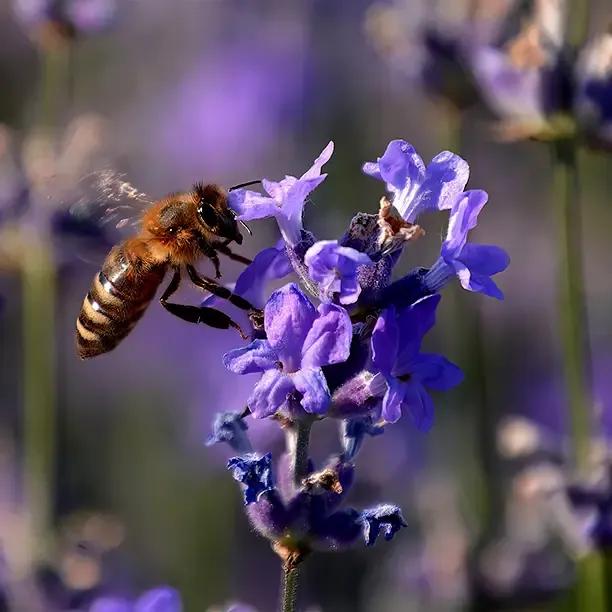
The Beezee breeding programme (Dutch, focused on uniformity and pot performance) produced a lavender that flowers heavily on a small frame. That makes it one of the better choices for edging, low formal hedging, or containers where you want the scent without the plant eating half your patio. It flowers from June, typically peaks in July, and if you shear it back after the first flush you'll usually coax a lighter second round in late August. Oil content is high, so the scent carries well on warm evenings. Bees treat it as a canteen.
One thing worth knowing: in very rich, moist soil it will grow leggier than you want. Lavender genuinely prefers poor ground. If your soil is heavy clay, work in plenty of grit at planting time, or grow it in a raised bed where drainage is under your control.
Where Beezee Dark Blue Earns Its Keep
This is a lavender that suits repetition. A line of Beezee Dark Blue along a path edge or flanking a front door gives you that Provençal look without the Provençal climate, and because the plants are bred for uniformity, they grow at roughly the same rate and hit roughly the same height. (Not identically — they're plants, not soldiers — but close enough that the eye reads it as a hedge rather than a crowd.) For a longer run of lavender hedging, spacing at 25–30cm apart works well. Closer than that and they'll merge too quickly; wider and you'll wait two seasons before the gaps fill in. If you want to mix blue and white along the same line, Arctic Snow has a similar compact habit and won't outgrow its neighbour. That combination of deep blue and clean white is a reliable one, though it does look better in person than it sounds on paper.
In containers, Beezee Dark Blue is among the most forgiving lavenders you can grow. A 30cm terracotta pot, loam-based compost with extra grit, and a sunny spot is all it needs. Water when dry. Don't fuss over it.
Planting Companions
For a formal front garden or courtyard, pair Beezee Dark Blue with Hidcote Blue Lavender as a taller backdrop — Hidcote runs to about 60cm and gives you a second tier behind the Beezee. Munstead Lavender is another English type at a similar height, useful if you want a softer lilac-pink tone mixed in. For something completely different in the same dry, sunny conditions, Common Rosemary grows well alongside lavender and extends the season of interest through winter with its evergreen habit. Salvias (especially Salvia nemorosa 'Caradonna'), Nepeta 'Walker's Low', and low-growing Sedums are all happy in the same lean, well-drained soil. Avoid pairing lavender with anything that needs regular watering — you'll end up compromising one or the other.
Why Buy from Ashridge?
Our lavender plants are established in 9cm pots, grown in the UK, and dispatched by next-day courier. Every plant is checked before it leaves — if it's not looking right, it doesn't go. We include a one-year plant guarantee as standard, and if you need advice on spacing, soil prep, or which variety suits your spot, there are real people on the phone here in Somerset who can help. We hold a Feefo Platinum Service Award, which is based on verified customer reviews rather than anything we've written about ourselves. Browse the full lavender collection or the English lavender range if you're still deciding.
Frequently Asked Questions
How is Beezee Dark Blue different from Hidcote?
Hidcote is the classic English lavender — taller (around 50–60cm), with a slightly more open habit. Beezee Dark Blue stays about 30–40cm and holds a tighter dome shape, which makes it better for low edging, containers, and small gardens. The flower colour is comparable — both are deep violet-blue — but Beezee's compact frame means the spikes sit closer together, so the colour impact per square centimetre is arguably stronger. (Arguably? No, it is stronger. More flowers, smaller plant.)
Can I grow Beezee Dark Blue in a pot?
Yes, and it's one of the best lavenders for it. Use a pot at least 30cm across, loam-based compost (John Innes No. 2 works well) with a generous handful of horticultural grit mixed through, and make sure the pot has drainage holes. Water when the top couple of inches of compost feel dry. Don't water on a schedule — check with your finger. Overwatering kills more potted lavender than cold weather ever does.
When should I prune it?
After flowering, typically late August or early September. Cut back the spent flower stems and about 2–3cm of the current year's leafy growth. The aim is to keep the dome shape neat and prevent it going woody and bare in the centre. Don't cut into old wood — English lavender won't regenerate from bare brown stems the way rosemary sometimes can. A second, lighter tidy-up in spring (March or April) catches any frost-damaged tips.
Will it survive a cold winter?
English lavenders are hardy to around minus 15°C in well-drained soil. The danger isn't cold itself — it's cold plus wet. Waterlogged roots in winter will kill lavender faster than any frost. If your soil is heavy, plant on a slight mound or add grit to the planting hole. In exposed northern gardens or frost pockets, a light mulch of gravel (not bark — bark holds moisture) around the base helps.
How many plants do I need for a hedge?
For a continuous low hedge, plant at 25–30cm spacing. So a one-metre run needs 3–4 plants, a five-metre run needs roughly 17–20. They'll take a full growing season to knit together, sometimes two depending on your soil and how much sun they get. Plant in spring or early autumn for best establishment.
Is it good for drying?
Very good. The dense flower spikes and high oil content mean the scent holds well after drying. Cut the stems just as the lowest flowers on each spike begin to open — that's when the oil concentration peaks. Hang them upside down in small bunches somewhere warm and dry, out of direct sunlight. They'll be ready in a couple of weeks. The deep colour fades a little on drying but stays blue enough to look good in arrangements or sachets.
Do I need to feed lavender?
No. In fact, feeding lavender usually makes things worse — you get more leaf, fewer flowers, and a floppy habit. Lavender evolved on thin, stony Mediterranean hillsides and performs best when slightly hungry. If your soil is already fertile, that's fine, but don't add compost or fertiliser at planting time. The one exception is potted lavender in its second year, which can benefit from a very light liquid feed (half-strength tomato food) once in late spring. Once. Not weekly.
Shipping Notes
- Free Standard Shipping on $100+ Orders to the USA.
- Except Preorder products are shipped in 48 hours.
- Delivery to the USA:
- Standard Shipping : 3-10 business days
- If time is of the essence, please consider selecting expedited delivery for faster service.
Exchange/Return Notes
- We offer a 30-day return/exchange service after receiving.
- Final sale items are not eligible for returns or exchanges.
- To process your return/exchange, please contact us at [email protected]
- Please click here for more details>>> Return & Exchange Policy