Pay in installments of $5.48 with
 ,
,
 and
and

Shipping Estimate
USA
- USA
- CAN
- USA
- CAN
Ships within 48 hours · Estimated delivery Aug 9 - Aug 14
 Promo Codes Available:
For Your Every Summer RSVP, with Code: SUMMER15
Description
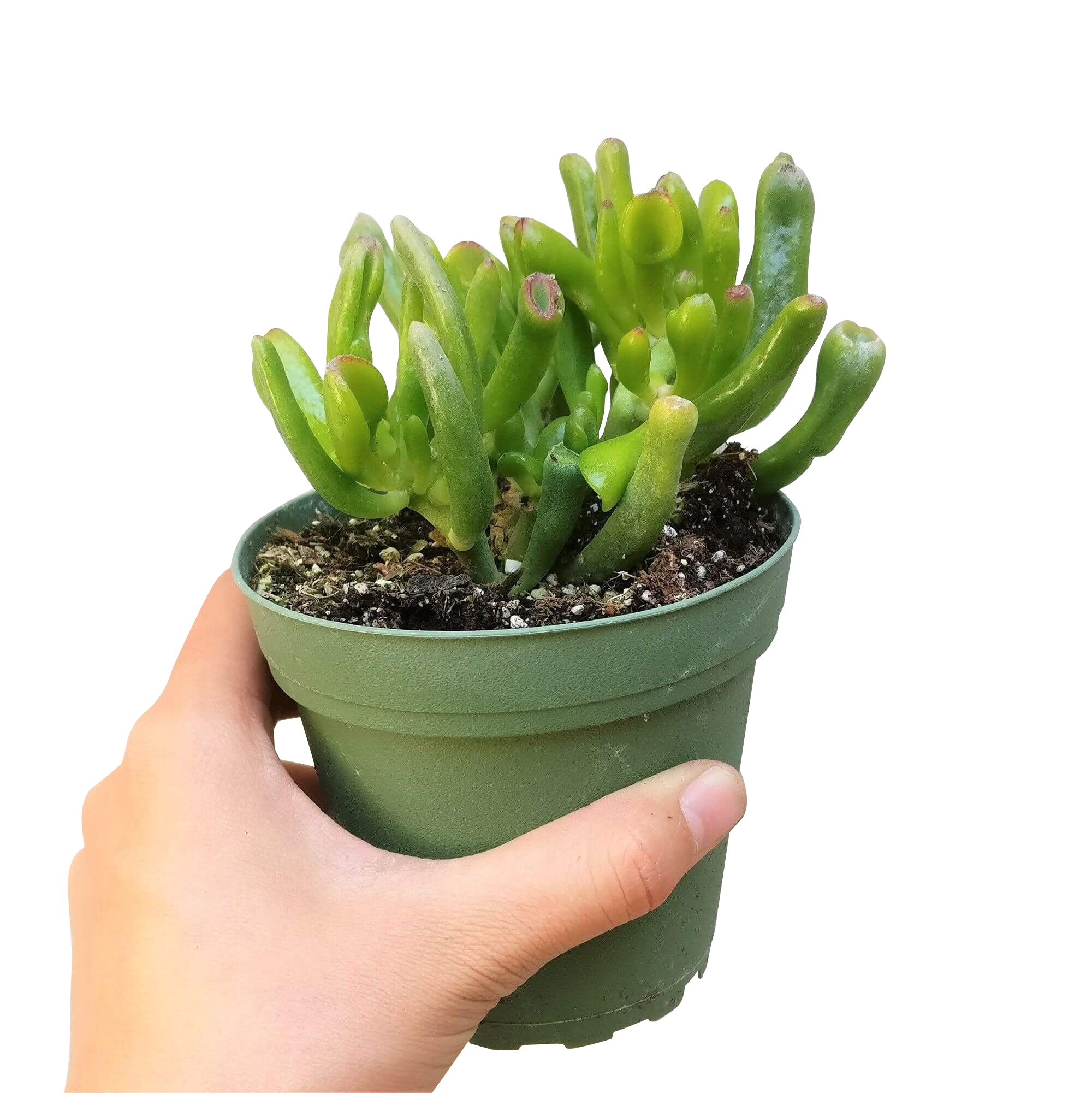
gollum jade plant for sale Gollum Jade CrassulaDescription Light Soil Water Hardiness Crassula Ovata 'Gollum Jade', also known as Jade Plant, Lucky Plant or Money Plant, is a fun succulent with cute chubby tubular leaves shaped like little fingers. The leaves are bright to dark green with red tips that show in cold weather. Crassula Ovata Gollum Jade" has thick succulent stems that root easily when propagated. It's very low maintenance and can be easily grown as a houseplant. In late winter or
-
Crassula Ovata 'Gollum Jade', also known as Jade Plant, Lucky Plant or Money Plant, is a fun succulent with cute chubby tubular leaves shaped like little fingers. The leaves are bright to dark green with red tips that show in cold weather. Crassula Ovata ‘Gollum Jade" has thick succulent stems that root easily when propagated.
It's very low maintenance and can be easily grown as a houseplant.
In late winter or spring, it produces clusters of starry white flowers.
See more about How to take care of Gollum Jade Crassula.
All of the plants may be shipped bare root. -
Full sun to partial shade.
A well-drained succulent mix. Optimal pH is around 6.0 (slightly acidic).
Average summer temperatures from 65ºF/18ºC to 70ºF/21ºC are ideal. In winter, it can survive temperatures as low as 50ºF/10ºC.
Feed once with a controlled-release fertilizer at the beginning of the growing season.
You can propagate Crassula Ovata Gollum Jade by division, offsets or leaf cuttings. The easiest way is to propagate from a single leaf: put the leaf in a succulent or cacti mix, then cover until it sprouts.
Can be toxic to humans and animals -
USDA Zone 8b: to -9.4 °C (15 °F)
USDA Zone 9a: to -6.6 °C (20 °F)
USDA Zone 9b: to -3.8 °C (25 °F)
USDA Zone 10a: to -1.1 °C (30 °F)
USDA Zone 10b: to 1.7 °C (35 °F)
USDA Zone 11: above 4.5 °C (40 °F)
Shipping Notes
- Free Standard Shipping on $100+ Orders to the USA.
- Except Preorder products are shipped in 48 hours.
- Delivery to the USA:
- Standard Shipping : 3-10 business days
- If time is of the essence, please consider selecting expedited delivery for faster service.
Exchange/Return Notes
- We offer a 30-day return/exchange service after receiving.
- Final sale items are not eligible for returns or exchanges.
- To process your return/exchange, please contact us at [email protected]
- Please click here for more details>>> Return & Exchange Policy
4.2 ★★★★★
Based on 8 reviews
Sort
Product Reviews
★★★★★ 5
Beta, Alpha, Omega oh my!
Format: Kindle
Omegas are precious and given to Alphas & their packs... but the Betas want in too. To this end, the Beta government is rolling out its trial of assigning a Beta to each Alpha-Omega pack. But forcing a Beta into a pack where they are not wanted will not end well... Of course, no one expected the Omega to fall for the assigned Beta. Great read and cliffhanger
WAS THIS REVIEW HELPFUL?YesReportShare
Reviewed in the United States on February 15, 2025
★★★★★ 3
A familiar story, just with…..less.
Format: Kindle
So, as other reviewers make clear, this is very similar to Pack Darling and The Beta. It’s much closer aligned with The Beta, in plot and maybe more like Pack Darling with characters.
That being said, I don’t hate this…..but it wasn’t great either. It’s both books mentioned but just….less. Less angst, less emotion, less feeling. The plot feels very half fleshed out, and the “bad guy” feels underwhelming. I didn’t really feel any real emotions from and of the male leads, except maybe Oliver. The others fell sorta flat for me. And Mika makes herself out to be this big bad ass straight outta training and then we never see it from here again with the one fitting room incident as the exception.
SPOILER:
The whole, “Oh, I’m actually probably an Omega, but I don’t wanna be but I do actually wanna be but no one can ever know my secret that I do nothing to hide “ thing fell so flat. She never commutes to believing she was secretly an omega, but also mentions her “secret” a lot. It just felt so manufactured.
I’m intrigued enough to read part 2 and see how the author closes everything out, but this is not one I’ll recommend or ever come back to.
WAS THIS REVIEW HELPFUL?YesReportShare
Reviewed in the United States on February 13, 2024
★★★★★ 5
Good start to a series
Format: Kindle
I delayed reading the series for reasons I don’t remember. But my TBR list is huge so I thought I’d take a shot of this and I was pleasantly surprised. I didn’t think the blurb about it was anything special. But it was a very good book. It took some interesting twists and turns. I am so glad the second book is already out. Because I would not have waited patiently. Very slow burn but good storyline. 🔥🔥/5
WAS THIS REVIEW HELPFUL?YesReportShare
Reviewed in the United States on January 3, 2025
★★★★★ 4
A good read
Format: Kindle
Multiple points of view. 3 Alpha men and an Omega male. She is a Beta in training for a new program placing betas in Alpha/Omega packs. Mila is only doing the program for the money to take care of her dad. She wasn't expecting to fall for a pack but when she sees this packs Omega she is done for. There is just something about him. His Alphas are good looking as well. Too bad she is hiding a secret and their government is acting shady. I liked it and can't wait to see where their story goes.
WAS THIS REVIEW HELPFUL?YesReportShare
Reviewed in the United States on November 14, 2023
★★★★★ 3
Slightly repetitive but I did love some things
Format: Kindle
I love this type of story. And omegaverse is one of my all time favorite genres. But there are a few things that pulled me out of my enjoyment while I was reading. It was repetitive at times as well as struggled with telling not showing. So we didn’t always feel like we were experiencing things with the main character. There were also some plot holes but they may still be answered in part 2.
Now this isn’t to be said I didn’t enjoy parts of the story. I loved the almost instant love between Mila and Oliver. And how he started changing around her.
WAS THIS REVIEW HELPFUL?YesReportShare
Reviewed in the United States on February 15, 2024