Pay in installments of $5.79 with
 ,
,
 and
and

Shipping Estimate
USA
- USA
- CAN
- USA
- CAN
Ships within 48 hours · Estimated delivery Aug 6 - Aug 11
 Promo Codes Available:
For Your Every Summer RSVP, with Code: SUMMER15
Description
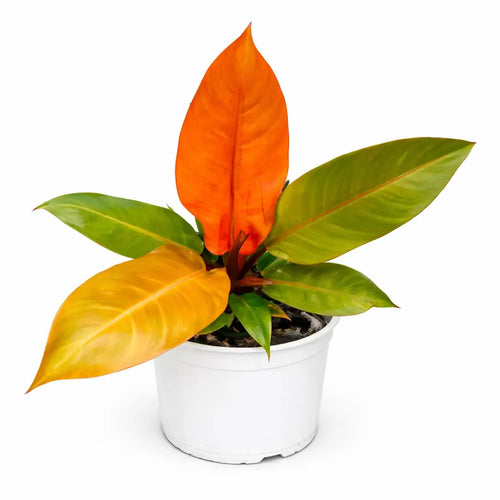
philodendron prince of orange climbing Philodendron 'Prince of Orange'The Philodendron 'Prince of Orange' is one of those rare plants that earns its name without any exaggeration. Every new leaf that unfurls does so in vivid orange deep, saturated, genuinely the colour of a ripe citrus then spends the following weeks travelling through copper and amber and chartreuse before settling into the rich, glossy dark green of a mature leaf. Because the plant pushes new growth continuously, multiple stages of this journey are
The Philodendron 'Prince of Orange' is one of those rare plants that earns its name without any exaggeration. Every new leaf that unfurls does so in vivid orange — deep, saturated, genuinely the colour of a ripe citrus — then spends the following weeks travelling through copper and amber and chartreuse before settling into the rich, glossy dark green of a mature leaf. Because the plant pushes new growth continuously, multiple stages of this journey are always visible simultaneously: a fully orange new spear at the centre, copper leaves mid-transition, and deep green mature leaves forming the outer canopy. No two moments in the growing season look quite the same. A hybrid of the *Philodendron erubescens* lineage — *erubescens* meaning "blushing" in Latin, a name suddenly made literal by the Prince of Orange's extraordinary leaf colour — it is entirely self-heading: it grows as a compact, symmetrical rosette without climbing, without needing a moss pole, and without taking over a room. At 60–90 cm at maturity it is perfectly scaled for desks, shelves, and tabletops, and it is one of the fastest-growing self-heading Philodendrons available.
Light
▾
Bright indirect light — the most important factor for a vivid, long-lasting orange display. An east or west-facing window is ideal; a south-facing window with a sheer curtain works well. The orange phase is most intense and lasts longest in bright conditions — in lower light the new leaves transition to green quickly and the distinctive colour display loses much of its impact. No direct harsh afternoon sun — it scorches and bleaches the leaves. Gentle morning sun is fine and beneficial. A grow light at 12–14 hours is excellent and produces the most consistently colourful new growth.
Watering
▾
Allow the top 3–5 cm to dry before watering thoroughly. The Prince of Orange prefers to dry out a little more between waterings than moisture-loving aroids — consistent soggy soil causes root rot faster in self-heading forms. Use room-temperature filtered water where possible. Empty the saucer after watering; never allow to sit in standing water. Reduce frequency slightly in winter but never allow to dry out completely. Check weekly; water when the top layer is clearly dry rather than just slightly dry.
Humidity
▾
50–70% preferred — a humidifier is beneficial but not essential. The Prince of Orange is more humidity-tolerant than many collector aroids and adapts well to typical Indian indoor conditions. Keep away from cold AC drafts and heating vents. Do not mist directly onto the leaves — water sitting on the new orange leaves encourages brown spotting, particularly on the tender young growth. India's tropical climate is naturally adequate for outdoor or semi-outdoor growing.
Growing Media
▾
Well-draining aroid mix — 40% quality potting soil, 25% orchid bark, 25% perlite, 10% coco coir. pH 5.5–7.0. The mix must drain freely; self-heading Philodendrons are more susceptible to root rot from compacted, moisture-retentive mixes than climbing forms. Repot every 1–2 years in spring, one pot size up — the plant prefers to be slightly snug rather than over-potted. A pot with drainage holes is essential; terracotta is a good option for extra drainage insurance.
Feeding
▾
Balanced liquid fertilizer at half strength every 2–3 weeks in spring and summer. The fast growth rate means consistent feeding during the growing season is visibly rewarded — larger leaves and more frequent new growth flushes. Apply to moist soil only. Flush every 3 months to prevent mineral salt build-up. Stop feeding in autumn and winter. Avoid high-nitrogen formulas — they push very fast leafy growth that outpaces the plant's structural development.
New Leaves Coming Out Green, Not Orange
▾
Insufficient light — the most common complaint. The orange phase shortens and fades dramatically in low light; in deep shade new leaves can emerge barely orange at all. Move to a significantly brighter indirect position or add a grow light. The colour will return to full intensity within 1–2 new growth cycles in better light. This is not reversion — the plant cannot revert; it is purely a light response.
Brown Spots on New Orange Leaves
▾
Water contact on tender new leaves — do not mist; ensure watering does not splash onto unfurling leaves. Also check for thrips, which target new growth specifically: silver streaking or distorted unfurling leaves indicate thrips. Treat with spinosad spray every 5–7 days for 4 weeks and quarantine immediately.
Yellow Leaves
▾
Overwatering or root rot — allow the top 3–5 cm to dry before watering. One older lower leaf yellowing as new growth pushes is normal cycling. Widespread yellowing with soggy soil: unpot, inspect roots, trim any blackened or mushy sections, repot in fresh well-draining mix, and water less going forward.
Leaves Staying Small
▾
Insufficient light, underfeeding, or the plant being too root-bound to support larger leaf production. Move to a brighter position, begin consistent feeding every 2–3 weeks, and check whether the plant needs repotting — roots circling the base of the pot indicate it is ready for the next size up.
Leggy or Lopsided Growth
▾
The plant is reaching toward its light source — rotate a quarter turn every 2–3 weeks to maintain even, symmetrical growth. If the plant has become significantly lopsided, increase overall light levels and begin regular rotation to gradually correct the form.
📋 Quick Plant Profile
| Botanical Name | Philodendron erubescens 'Prince of Orange' |
| Name Meaning | erubescens = Latin for "blushing" — the vivid orange-red new leaf colour taken to its most dramatic expression |
| Common Names | Prince of Orange, Orange Splendor (Indian market trade name) |
| Family | Araceae |
| Colour Journey | Vivid orange → copper → amber → chartreuse → deep glossy green; all stages visible simultaneously |
| Colour Type | Stable genetic trait — not variegation; every new leaf will be orange; does not revert |
| Colour Key | More light = longer, more vivid orange phase; less light = faster transition to green |
| Growth Habit | Self-heading rosette — does not climb; no moss pole needed; compact and symmetrical |
| vs. erubescens Emerald Queen | Same lineage; Emerald Queen is a climber with cream variegation; Prince of Orange is self-heading with orange new growth |
| Light | Bright indirect; no direct harsh sun; grow light excellent; low light fades orange phase |
| Watering | Top 3–5 cm dry between waterings; well-draining mix essential; do not sit in water |
| Humidity | 50–70%; adaptable; no misting on leaves; humidifier beneficial but not essential |
| Temperature | 18°C–30°C; no cold drafts; thrives in Indian indoor conditions |
| Mature Size | 60–90 cm height and spread; compact; ideal for desks, shelves, and tabletops |
| Growth Rate | Fast for a self-heading Philodendron — new leaves in frequent succession with good light and feeding |
| Rotation | Quarter turn every 2–3 weeks for even, symmetrical growth |
| Ideal For | Desks, Shelves, Tabletops, Bright Rooms, Collectors, Gifting, Beginners and Experts Alike |
| Care Level | Easy to intermediate — bright light is the one non-negotiable; everything else is forgiving |
Shipping Notes
- Free Standard Shipping on $100+ Orders to the USA.
- Except Preorder products are shipped in 48 hours.
- Delivery to the USA:
- Standard Shipping : 3-10 business days
- If time is of the essence, please consider selecting expedited delivery for faster service.
Exchange/Return Notes
- We offer a 30-day return/exchange service after receiving.
- Final sale items are not eligible for returns or exchanges.
- To process your return/exchange, please contact us at [email protected]
- Please click here for more details>>> Return & Exchange Policy