SKU: 55138073418
anthurium hookeri variegated

anthurium hookeri variegated Anthurium hookeri variegata

Sale price$24.06 Regular price$26.73
Save 10%

Shipping Estimate
USA
  • USA
  • CAN

Ships within 48 hours · Estimated delivery Jul 11 - Jul 16

Promo Codes Available:

For Your Every Summer RSVP, with Code: SUMMER15

Description

anthurium hookeri variegated Anthurium hookeri variegataAnthurium hookeri variegata Anthurium hookeri variegata grows as a broad birds nest rosette of firm green leaves with irregular cream, pale green or yellow green variegation. New leaves rise from the centre and expand outward, giving mature plants a wide, sturdy crown. The pale sections contain less chlorophyll than the green tissue. They create the variegated pattern, and they can mark faster when light is harsh, the air is very dry or watering

Anthurium hookeri variegata

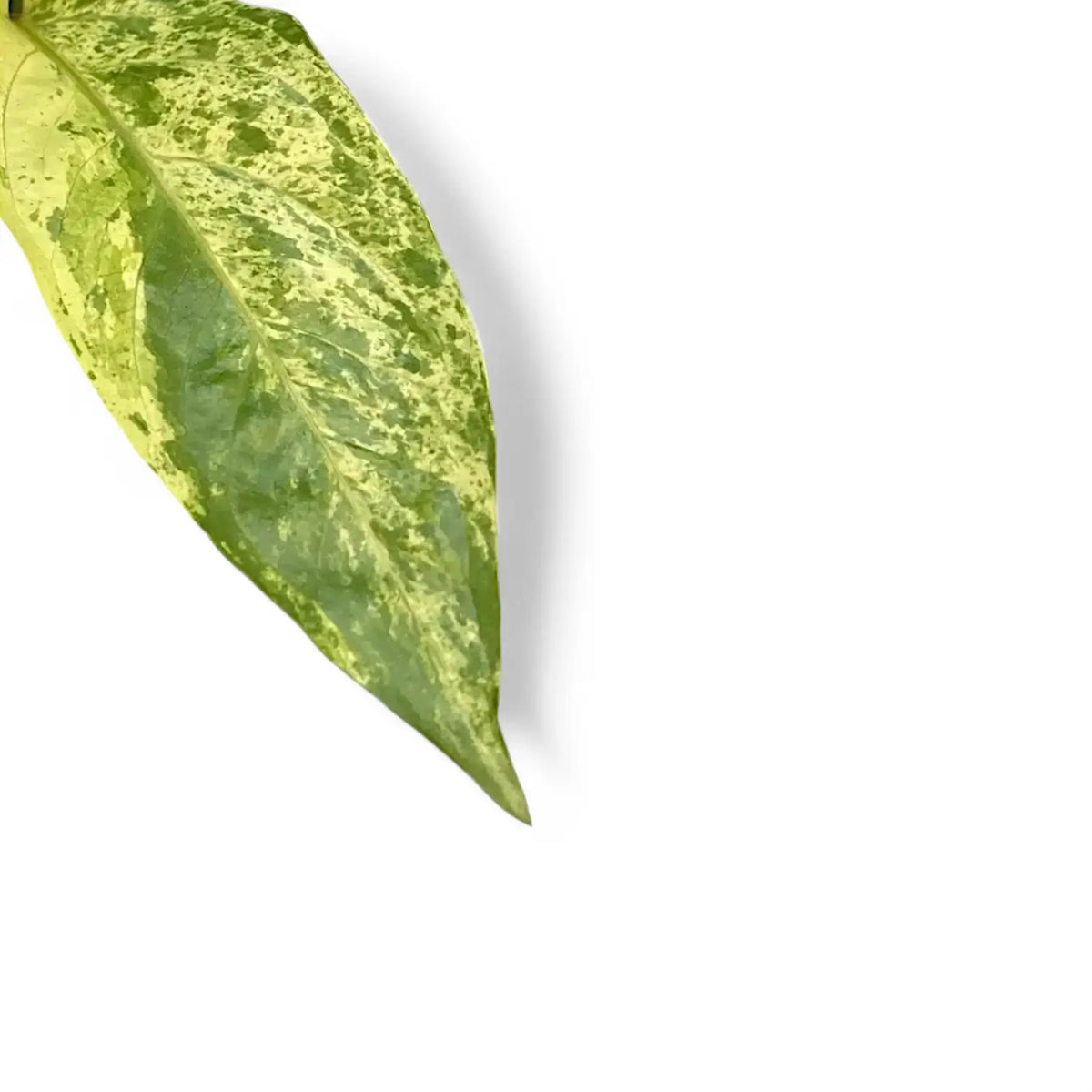
Anthurium hookeri variegata grows as a broad bird’s-nest rosette of firm green leaves with irregular cream, pale green or yellow-green variegation. New leaves rise from the centre and expand outward, giving mature plants a wide, sturdy crown.

The pale sections contain less chlorophyll than the green tissue. They create the variegated pattern, and they can mark faster when light is harsh, the air is very dry or watering swings too far between wet and dry.

Variegated bird’s-nest growth

  • Growth: Rosette-forming bird’s-nest Anthurium with leaves emerging from the centre.
  • Leaf texture: Firm, leathery green leaves that broaden with maturity.
  • Variegation: Cream, pale green or yellow-green sections that vary from leaf to leaf.
  • Pale sectors: Pale tissue has less chlorophyll and browns faster than green tissue under stress.
  • Petioles: Often sturdy at the leaf base; exact shape can vary between plants.

Bird’s-nest growth and origin

Anthurium hookeri variegata forms a variegated bird’s-nest rosette with firm patterned leaves. True A. hookeri comes from the Caribbean and northern South America. In cultivation, bird’s-nest Anthuriums sold under this name can differ in leaf and petiole details.

Airflow around the crown and an open root mix help prevent soft new growth. Bright filtered light supports growth while keeping the pale sections away from harsh sun.

Anthurium hookeri variegata care

  • Light: Give bright filtered light to support growth while protecting the pale sectors from scorching.
  • Watering: Water thoroughly, then let the upper part of the mix become lightly dry before watering again.
  • Substrate: Use a chunky aroid mix with bark, coco chips or coarse coco fibre, pumice or perlite.
  • Pot choice: Use a stable pot with drainage. Mature rosettes become wider and heavier.
  • Variegation: Pale sectors contain less chlorophyll than green tissue and can brown faster in strong sun or unstable care.
  • Humidity: Moderate to high humidity helps new leaves expand cleanly. Keep air moving around the crown.
  • Temperature: A steady warm spot around 20–28 °C is ideal for active growth.
  • Feeding: Feed with a gentle fertiliser during active growth to reduce the risk of salt buildup on broad leaves.
  • Repotting: Refresh the pot when roots fill it, the plant dries unusually fast or the mix begins to collapse.
  • Leaf care: Wipe mature leaves with a soft damp cloth and keep the centre of the crown from staying wet.
  • Propagation: Propagate by separating offsets or divisions with their own roots. Divisions are the best way to keep the same variegated pattern.

Common issues with Anthurium hookeri variegata

  • Brown pale sectors: Check for harsh sun, repeated drying, dry air or mineral buildup.
  • Yellowing lower leaves: Often linked to a cold, wet lower pot or stressed roots.
  • Soft crown growth: Water sitting in the centre, poor airflow or wet substrate can damage new growth.
  • Stalled new leaves: Check roots, warmth and moisture consistency before increasing fertiliser.
  • Pests in the crown: Inspect leaf bases and undersides for mealybugs, scale and mites.

Flowering and berries

Older bird’s-nest Anthuriums may produce a spathe and spadix. Berries can form only after successful pollination. Indoors, flowering is occasional; growth usually stays centred on the rosette.

Toxicity and sap

Anthurium hookeri variegata contains calcium oxalate crystals. Keep it out of reach of pets and children, and keep sap away from eyes or sensitive skin.

What “variegata” means here

Anthurium refers to the spadix, and hookeri honours William Jackson Hooker. Here, “variegata” describes the pale patterning on the leaves.

Warm roots, filtered light and steady watering help reduce browning on the pale leaf sections.

Shipping Notes
  • Free Standard Shipping on $100+ Orders to the USA.
  • Except Preorder products are shipped in 48 hours.
  • Delivery to the USA:
  1. Standard Shipping : 3-10 business days
  • If time is of the essence, please consider selecting expedited delivery for faster service.
Exchange/Return Notes
  • We offer a 30-day return/exchange service after receiving.
  • Final sale items are not eligible for returns or exchanges.
  • To process your return/exchange, please contact us at [email protected]
  • Please click here for more details>>> Return & Exchange Policy
SKU: 55138073418

Discover Niche Categories That Outsell anthurium hookeri variegated

Top-Converting Item to Boost Your Average Order

4.1 ★★★★★
Based on 44 reviews
Sort
Highest Rating
Newest First
Oldest First
Product Reviews
K
Kirsten
Los Angeles, US
★★★★★ 5
Holds a decent amount of jewelry!
Color: Carbonized Brown, Color: Carbonized Brown
I was quite impressed with this little jewelry box. Although it is on the smaller side, it utilizes every bit of the storage space available really well. I’d ultimately love to get a bigger armoire- as it is, this jewelry box contains what I wear most often, but I have a larger collection than this particular jewelry box can hold- my plan is to find a larger jewelry armoire that resembles what my mother had because I loved that one and then passed this one down to my daughter who loves it. For its size, it does absolutely hold a lot. I definitely underestimated how much it would hold. I love that there are drawers and well. I would love to see the ring area hinged so that I don’t have to reposition it when I’m done grabbing my rings, I think it’s a really cool, unique way to approach that particular area. I love that every little bit at this jewelry box is designed to have utility. I hate wasting space and time and I love good organization so it’s been really nice being able to pack as much as I can in there. The top opens up to space for earrings and other miscellaneous items. There are both open and more structured components. And the space for bracelets rotates, which is really nice- I didn’t realize that it rotated and I was a little bit worried that I was gonna constantly knock things down while I was reaching through or something. There is lots of room inside both doors for necklaces, and it fits a lot more than I thought it would. The wood stain is a really pretty kind of ashy natural stain- the sort of grey tint is really nice and it’s gorgeous. I’m not a huge fan of mirrors as far as the front goes, but I do have an artist in house who is really good at coming up with stuff for this, just a little ways to put art in your every day, so I’ll probably have her paint over. The jewelry box also doesn’t take much space up at all. While I am looking for something with a little bit larger footprint, I don’t necessarily want to waste a bunch of real estate in the meantime so I’m really pleased with how compact it is. This is a great little jewelry box - as I mentioned it doesn’t house all of my jewelry, but that’s because my collection is mostly heirloom and I don’t want to take it out from where it is right now. If it were larger, I would probably do so but for now it just houses my everyday items and a little bit extra. I think it’s great and I’m super happy with it!
WAS THIS REVIEW HELPFUL?YesReportShare
Reviewed in the United States on March 17, 2026
X
Verified Purchase
0x00000000:00000000
Waukegan, US
★★★★★ 5
Excellent book, possibly currently unique in coverage of latest ideas
This book is possibly currently unique in its coverage of the latest ideas in the field of deep learning -- and it is a very convenient and good survey of fundamental concepts (linear algebra, optimization, performance metrics, activation function types), different network types (multi-layer perceptron, convolutional neural networks, and recurrent neural networks), practical considerations (data set, training and validation, implementation), and applications (comments on existing real-world/commercial uses). The final 235 pages of the content portion of the book is dedicated to topics in "Deep Learning Research", and these topics are truly at the current frontier. Another reviewer said that one could gain the same knowledge of cutting-edge research by reading all of the latest papers (from academia and industry), but the "research" section of this book offers the following: Selection of the most notable research by the very experienced authors of the book, and collection of similar research in to a broader discussion of themes, and the additional insights. The book covers very advanced and new ideas currently being explored, and it is very nice to be able to have a consistent and coherent presentation of all of those ideas. However, the book is also packed with valuable observations and pointers about more basic aspects of deep learning implementations and practices -- and such commentary is in depth and includes substantial analysis and mathematical derivation (in an intuitive presentation that often includes graphs illustrating the phenomenon). As someone with an intermediate level of knowledge and experience of neural networks, I am really grateful for this book, because seems like the ideal resource for learning cutting-edge ideas and practices, with context. The book has excellent scope and depth, and I am confident that anyone with a solid background in linear algebra, calculus, statistics, and general machine learning, and basic neural networks (multi-layer perceptrons) will find this book to be very exciting and perhaps unique in its ability to take the reader to the next level and a new frontier. I was personally excited to learn about the idea of representing the dependencies of intermediate quantities by directed graphs, and how this can be used to perform calculations for recurrent neural networks efficiently. And I think the long chapter on recurrent neural networks is very helpful. Having said all of this, I think only people with significant working knowledge and experience with neural networks and mathematics -- people whose academic or professional focus has been neural networks for at least a year or two -- would benefit from this book. This book answers a lot of the deeper questions that one is likely to have while developing a solid understanding of the fundamentals, and that's one of the book's tremendous values, but this book assumes an understanding of the fundamentals (but does briskly cover the basics). I think this book is a perfect follow-up book for the excellent book "Neural Network Design (2nd edition)" by Hagan, Demuth, Beale, and de Jesus, and I highly recommend the latter for gaining the solid background needed to have a thrilling experience with the "Deep Learning" book. In summary, I am very glad this "Deep Learning" book was written, and I think the "Deep Learning" book will be a great benefit to a lot of people, and to the evolution of the field.
WAS THIS REVIEW HELPFUL?YesReportShare
Reviewed in the United States on April 18, 2017
Z
Verified Purchase
Zygerian99
New York, US
★★★★★ 5
The definitive guide to becoming a researcher in the field
Format: Hardcover
This is not a coding book. I see a lot of negative reviews around the expectation that this book would teach the reader how to quickly build machine learning systems and write code. This book is not for that audience. If you just want to build applications, don't worry about how deep learning works. It's akin to needing to understand how an engine works just to drive a car. If you are looking for a coding resource, try: https://www.amazon.com/Hands-Machine-Learning-Scikit-Learn-TensorFlow/dp/1492032646/ref=sr_1_4?keywords=machine+learning+tensorflow&qid=1579608765&sr=8-4 . And even with that book, the material still goes far beyond what you need - use it as a light reference. I bought this book as an aspiring machine learning researcher, and towards that end, it is the best resource available in print (still true as of 2020). For instance: The first 5 chapters are timeless. These are things that were mostly established 20 or 30 years ago and beyond and are mostly STEM fundamentals at this point. There are whole textbooks dedicated to each of those chapters, but the authors provide a quick refresher and overview of probably 80% of what you'll encounter in deep learning. If you haven't previously learned each of these subtopics, you'll probably want to study them individually since they are the key to innovating (linear algebra, probability & stats, numerical computation, machine learning fundamentals). Chapters 6 thru 9 are the foundation of deep learning. We're about 12 years into seeing rapid change in the deep learning space, yet all of these principles and techniques still hold (many recent innovations are still relying on Convolutional models in 2020, which is the most layered/complex topics in those chapters). Therefore, I'd wager that these chapters are also fairly stable knowledge that is worth internalizing if you want to be deeply involved in the future of machine learning. Chapters after 9 are mostly experimental topics, and many of them are already the wrong strategies for optimal results. But there are interesting ideas in here that you'll often encounter in the wild, so it's good exposure to various topics. But probably not worth much of your time. And lastly, there is good history in here from people who know the space intimately. It's a good way to piece together the developments and learn the lexicon of deep learning so you can have intelligent conversation with experts.
WAS THIS REVIEW HELPFUL?YesReportShare
Reviewed in the United States on January 21, 2020
S
Verified Purchase
Shannon
Chelsea, US
★★★★★ 5
The best DL/ML book I have ever seen!!
Format: Hardcover
Fantastic deep-learning book! The logic is very easy to follow, but the content is very thorough when it comes to explaining the theories behind it, making it perfect for beginners as well as math and CS students. The best DL/ML book I have ever seen!!
WAS THIS REVIEW HELPFUL?YesReportShare
Reviewed in the United States on November 30, 2025
W
Verified Purchase
William P Ross
Natrona Heights, US
★★★★★ 5
Comprehensive Look At An Incredibly Complex Topic
Format: Hardcover
Deep Learning is an advanced book with great explanations and details. There is a heavy math focus with the book's beginning chapters detailing the necessary linear algebra and probability that one will need to understand deep learning. I liked that the author's chose to cover only the parts of these subjects which are relevant to deep learning. There are many interesting philosophical sections in the book as well. Just about when I was feeling overwhelmed with the complexity of the mathematics the authors take a step back and cover the foundations of deep learning such as borrowing concepts from human learning. There was an interesting dicussion about the early studies done on the vision of cat's and monkey's in the 1970s. The text covers the entire history of deep learning and the bibliography is hundreds of sources. It is clear this is the most comprehensive text available about deep learning. For anybody interested in this topic this book is a mandatory read. There are sections about machine learning as well, which makes sense because deep learning is a subset of machine learning. These sections focused on the machine learning concepts which are most relevant to deep learning. The book was well organized and divided into three parts which cover mathematics related to deep learning, typical deep learning techniques, and then more experiment learning techniques. Often the author's state when a technique works well or when it does not, and which types of data works best for the technique. Just a warning, the math in this book is highly complex. It requires a lot of work to go through this book, but the effort will be well rewarded.
WAS THIS REVIEW HELPFUL?YesReportShare
Reviewed in the United States on March 15, 2017

recommand products