SKU: 63451731980
pointy palm plant

pointy palm plant Ponytail Palm

Sale price$23.47 Regular price$26.08
Save 10%

Shipping Estimate
USA
  • USA
  • CAN

Ships within 48 hours · Estimated delivery Jul 12 - Jul 17

Promo Codes Available:

For Your Every Summer RSVP, with Code: SUMMER15

Description

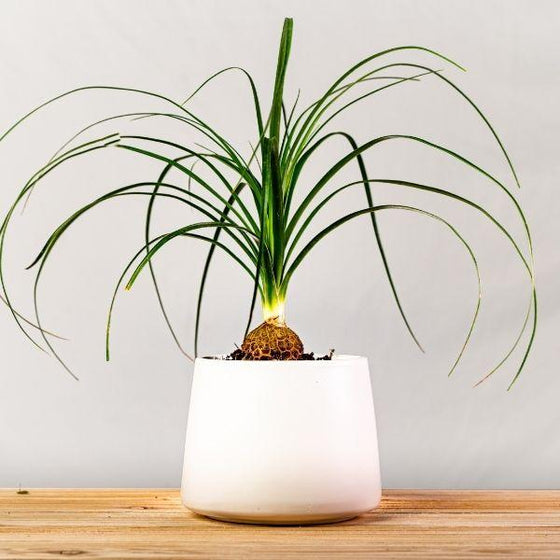
pointy palm plant Ponytail PalmCurly Ponytail Foliage on a Swollen Trunk Ponytail Palm is one of those plants that makes people smile at first glance. A swollen, bulbous base tapers into a slender trunk, crowned with a fountain of long, ribbon like leaves that spill over the sides like a green ponytail. Despite its common name, it isnt a true palm at all, but a caudex forming succulent native to Mexico, which has evolved to store water in its thick base. The look is part desert

Curly “Ponytail” Foliage on a Swollen Trunk

Ponytail Palm is one of those plants that makes people smile at first glance. A swollen, bulbous base tapers into a slender trunk, crowned with a fountain of long, ribbon-like leaves that spill over the sides like a green ponytail. Despite its common name, it isn’t a true palm at all, but a caudex-forming succulent native to Mexico, which has evolved to store water in its thick base. The look is part desert sculpture, part whimsical houseplant, and it fits just as well on a sunny windowsill as it does styled on a plant stand.

Slow, Compact Growth, and Long-Lived

Indoors, Ponytail Palm is slow-growing, which makes it a fantastic long-term companion plant. Young plants have a single trunk and a tight tuft of foliage, while older specimens gradually thicken their base and may branch into multiple heads over time. In containers inside the home, most plants typically top out at around 3–4 feet tall, although very old specimens in large pots can reach 5–6 feet. Because it grows slowly and stays relatively narrow, it’s easy to tuck into corners, tabletops, or grouped displays without worrying that it will outgrow the space overnight.

Bright Light and Infrequent Watering is all it requires

Think of Ponytail Palm as more of a succulent than a palm when it comes to care. It thrives in bright, indirect light and happily basks in a bit of gentle direct sun, especially morning or late-afternoon rays. A bright east or south window is ideal; in lower light, it will survive, but growth slows dramatically, and the trunk may elongate rather than stay stout. Plant it in a very well-draining mix—such as cactus or succulent soil, or potting mix heavily amended with sand and perlite—so that excess water runs through quickly and never lingers around the roots.

Watering is where Ponytail Palm really earns its “set it and forget it” reputation. The caudex stores water, so you’ll want to let the soil dry out completely between waterings, then soak thoroughly and drain well. In most indoor settings, that means watering every 2–4 weeks, less in low light or winter, and a bit more in bright, warm conditions. It prefers typical household temperatures of around 65–80°F and average humidity, shrugging off dry indoor air that would bother more finicky tropicals. Overwatering is just about the only way to truly get into trouble with this plant—if the base ever feels soft or the leaves pull out easily, it’s a sign the roots have stayed wet too long.

Pet-Safe Personality Plant for Home or Office

In the “indoor landscape,” Ponytail Palm is pure personality. Use it as a quirky focal point on a plant shelf, as a sculptural accent on a low stool, or lined up in multiples for a desert-inspired vignette. It pairs beautifully with cacti, snake plants, and other drought-tolerant houseplants, adding a softer, playful texture to an otherwise spiky or architectural grouping. And because it’s considered non-toxic to cats, dogs, and even horses, you can relax a bit if curious paws can’t resist playing with those tempting, dangling leaves.

Shipping Notes
  • Free Standard Shipping on $100+ Orders to the USA.
  • Except Preorder products are shipped in 48 hours.
  • Delivery to the USA:
  1. Standard Shipping : 3-10 business days
  • If time is of the essence, please consider selecting expedited delivery for faster service.
Exchange/Return Notes
  • We offer a 30-day return/exchange service after receiving.
  • Final sale items are not eligible for returns or exchanges.
  • To process your return/exchange, please contact us at [email protected]
  • Please click here for more details>>> Return & Exchange Policy
SKU: 63451731980

Discover Niche Categories That Outsell pointy palm plant

Top-Converting Item to Boost Your Average Order

4.1 ★★★★★
Based on 689 reviews
Sort
Highest Rating
Newest First
Oldest First
Product Reviews
S
Verified Purchase
Sailorman
Boise, US
★★★★★ 4
Great speculation from the "Alternative Camp"
Format: Paperback
According to John Anthony West it was not until the second half of the twentieth century that "guerilla scholarship" became a noticeable, if uncoordinated force in modern science. Guerilla scholarship of course, refers to the alternative camp or those that challenge orthodox views in science, archeology, anthropology, etc. If this book doesn't fall into the guerilla scholarship or alternative camp category it comes really close. Author Dr. Robert Schoch is of course the archeologist who some years ago, along with John Anthony West, shocked the scientific community and infuriated Dr. Zahi Hawass, Egypt's Director of Antiquity, by claiming that the Sphinx's construction predated Khufu, its alleged builder, by 3,000 years or more. While the controversy surrounding those claims has resulted in numerous books, both, pro and con, with no real accepted conclusions, in this book Schoch tries to develop the hypothesis that all of the pyramids constructed around the world have a common origin in Sundaland, which was inundated under 250 feet of water after the last ice age. If somebody could come across a pyramid or two (2), that predated the great pyramid, under that 250 feet of water it would certainly help Schoch's case, but be that as it may, Schoch, while not proving his hypothesis, does present a pretty convincing argument in support of his speculation. Schoch begins with a discussion in review of the theories for the age of Giza and other pyramid type structures around the world. He then provides very convincing evidence for his claim that humans traversed both the Atlantic and Pacific oceans eons before Columbus's 1492 voyage, which is the orthodox view of the first contact with the new world. He discusses how early humans might have accomplished this as well as their possible motives for doing so. Schoch concludes with where they came from, arriving at the common roots in Sundaland 10,000 years ago. This book probably has some of the longest, impossible to pronounce names, of people and places of any book that I have ever read; and a few maps of various parts of the world, particularly Europe, the Middle and Far East, and South America, would have helped a great deal in developing a mental picture of what was being related. All that aside, the book challenges the mind and causes one to think. I was particularly intrigued by Schoch's explanation as to how Moses was able to convince the pharaoh to allow him and his followers to leave Egypt, as well as Schoch's perfectly plausible explanation of what parted the waters of the Red Sea and subsequently drowned the pharaoh's army when the waters rushed back in. While maybe not as convincing as Schoch's earlier work, "Voices of the Rocks", Schoch presents convincing arguments and if you are a "guerilla scholar" you're going to love this book.
WAS THIS REVIEW HELPFUL?YesReportShare
Reviewed in the United States on February 24, 2008
K
Verified Purchase
K. Ryan Kane
Los Angeles, US
★★★★★ 5
This is a great book to begin your study on all the groups ...
Format: Paperback
This book isn't just about pyramids. It talks a lot about all the different groups and waves of people who traveled to the American continent, mostly the Latin American areas. There is so much information contained therein that I intend to read this book again. This is a great book to begin your study on all the groups who traveled to Latin America.
WAS THIS REVIEW HELPFUL?YesReportShare
Reviewed in the United States on May 14, 2018
R
Verified Purchase
Robert R.
Omaha, US
★★★★★ 5
Good read
Format: Kindle
Very well written, personable, and good research. Several references were made about Noah and Moses as if they were valid historical people and their related events, which most scholars agree were 'lifted' from Sumerian and Akkadian legends. Doesn't give much credit to Zechariah Sitchin, never even mentions Enlil and Enki - it's like talking about Kennedy's last trip to Dallas without mentioning the Grassy Knoll.
WAS THIS REVIEW HELPFUL?YesReportShare
Reviewed in the United States on September 28, 2015
A
Verified Purchase
Amazon Customer
Bozeman, US
★★★★★ 3
Interesting
Format: Hardcover
Great perspective and well-presented discussion. Beneficial for contemplation and developing hypotheses or questioning documented science to further discern evidence or seek new explanations. Recommend reading through a lens of correlation does not equal causation.
WAS THIS REVIEW HELPFUL?YesReportShare
Reviewed in the United States on April 8, 2026
K
Verified Purchase
Karla Crum
Houston, US
★★★★★ 5
Professional and fun to read
Format: Paperback
The book is written by a professional who provides ideas and reasons about possibilities without being dogmatic.
WAS THIS REVIEW HELPFUL?YesReportShare
Reviewed in the United States on February 20, 2022

recommand products