adenium succulent plants Shop 'Desert Rose - Adenium obesum' Care and Growing GuideThe Desert Rose, also known as 'Adenium obesum', is best loved for its long lasting, vibrant blooms that appear twice a year, once in early spring and again in late summer or early fall, with each blooming period lasting up to two months. Despite not being a true rose, this striking succulent steals the spotlight with its vibrant, trumpet shaped flowers and sculptural, bonsai like form. Native to Southwestern Africa, this succulent is a deciduous
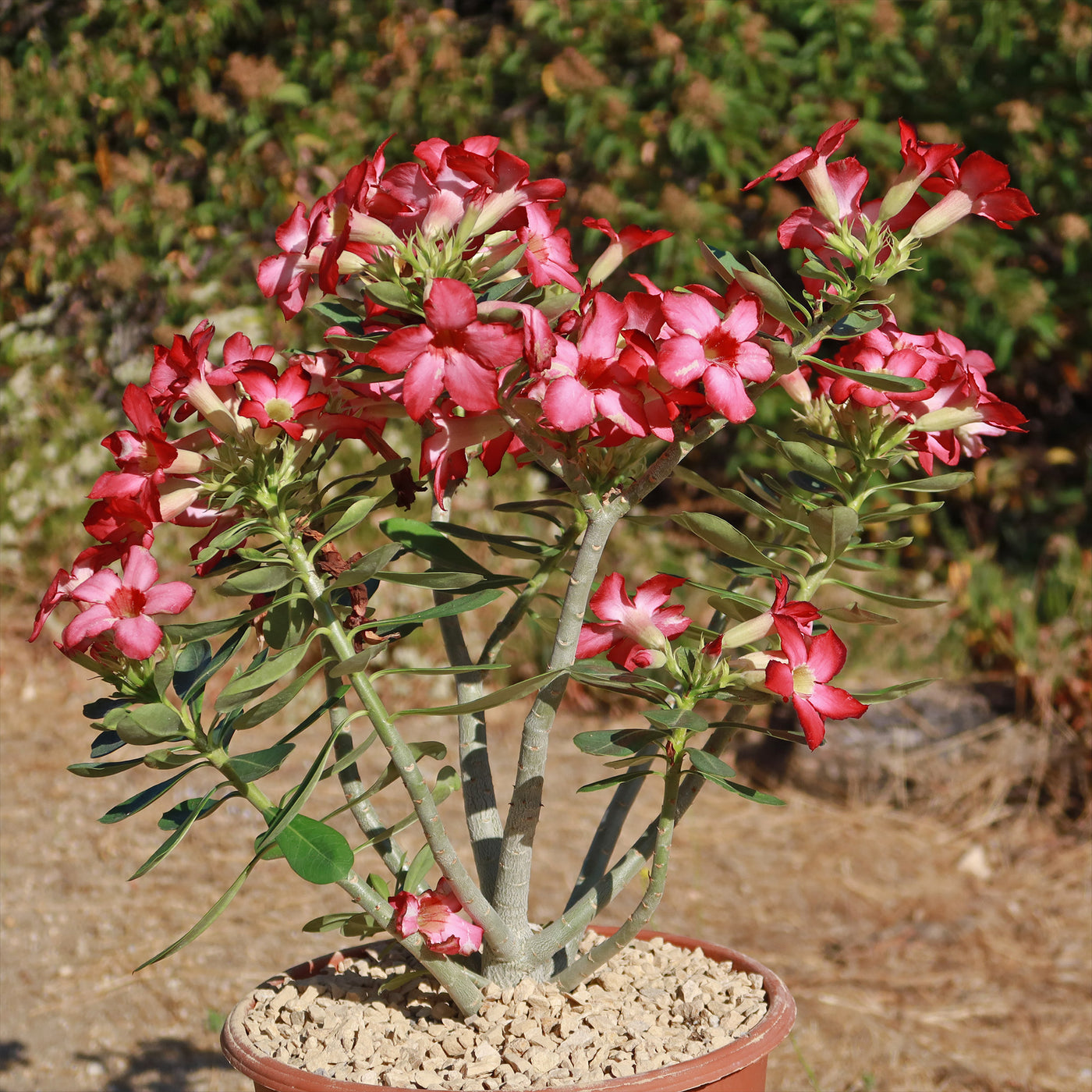
The Desert Rose, also known as 'Adenium obesum', is best loved for its long-lasting, vibrant blooms that appear twice a year, once in early spring and again in late summer or early fall, with each blooming period lasting up to two months. Despite not being a true rose, this striking succulent steals the spotlight with its vibrant, trumpet-shaped flowers and sculptural, bonsai-like form.
Native to Southwestern Africa, this succulent is a deciduous plant with a smaller caudex than Adenium arabicum, which is most frequently used as a desert rose bonsai plant.
It has long, narrow, and pointed leaves that grows in clusters at the tips of the branches.
The leaves are typically bright green, waxy with reddish edges, and shiny on both the upper and lower sides, distinguishing them from the arabicum (desert rose).
It can grow up to 9 feet tall and 5 feet wide, making it a true showstopper among other succulent plants.
The blooms of the low-maintenance desert rose plant are trumpet-shaped, bright pink, red, and white flowers that appear in spring and summer, have a sweet fragrance, and can last for several weeks.
This desert rose can be pruned to produce a compact canopy of leaves and flowers. There's no way to go wrong growing these gorgeous succulents as long as they're kept at the proper temperature!
When and How to Water Your Desert Rose Succulent
The desert rose plant is a drought-tolerant succulent, but it still requires a thoughtful watering routine, especially during its growing and dormant seasons.
Water your desert rose plant 7 to 10 days, during growing season and drop to about once every 3 to 4 weeks, during the dormant season.
In the spring and summer, water your plant only when the soil feels dry to the touch. Always ensure the soil drains well and the pot has proper drainage holes.
In the fall and winter, avoid overwatering as it can lead to root rot. Always use well draining soil and a pot with proper drainage holes so water does not sit around the roots.
You'll know it needs water if the stems start to shrivel slightly or show discoloration. This is the plant drawing from its internal moisture reserves. Once watered, the stems will plump up again as they rehydrate.
Desert Rose – Everything You Need to Know!
Known as Adenium obesum, it is a striking succulent shrub known for its thick, swollen trunk and vibrant, trumpet shaped blooms. It stores water in its caudex, giving it a sculptural, bonsai like look that stands out in any space.
Learn more →
Light Requirements - Where to Place Your Desert Rose Plant
When growing indoors, place it near a south- or west-facing window that receives 4-6 hours of bright, indirect sunlight.
If natural light is limited, you can supplement with a full-spectrum grow light for 12–14 hours a day.
Without enough light, indoor plants may grow leggy, fail to bloom, or become vulnerable to pests.
When growing outdoors, your plant thrives best with at least 6 hours of direct sun daily.
Avoid placing a young plant in full sun right away and gradually increase its exposure over one to two weeks to prevent sunburn.
Partial shade during the hottest part of the day can also help protect it in extremely hot climates. Gradually increase sun exposure over a week or two to prevent leaf burn.
Optimal Soil & Fertilizer Needs
The adenium desert rose like a very airy, porous, nutrient-rich soil with a pH of 5.5 - 6.5. It requires a fast-draining soil that dries completely between waterings. Ideally, you want to use our Go to soil cactus mix blend 1 gal 4 qt cacti succulent dirt compost growing mediaspecialized potting mix that contains 5 natural substrates and organic mycorrhizae to promote the development of a strong root system that helps your succulent to thrive.
When fertilizing your desert roses, keep it light and seasonal. Apply a balanced, low strength fertilizer once a year during spring. An NPK ratio around 5-10-5, works well to support both root growth and flowering.
Avoid overfeeding, as they are sensitive to excess nutrients. ith the right balance, your plant will grow well and produce better flowers.
Hardiness Zones & More
In the United States, the desert rose plant is mostly an indoor plant, but if you live in southern Florida or Hawaii, then you can cultivate it outdoors in USDA zones 10-12.
It prefers temperatures around 65°F to 75°F and can tolerate low to moderate humidity levels.
However, make sure air circulates well around the plant to reduce the risk of fungal problems, especially when grown indoors.
If you live in a colder climate, you should put them in a pot, and they can then be kept outdoors during the summer and brought in as the temperature drops.
How to Grow as a Houseplant
You can grow your desert rose succulent by giving it 6 - 8 hours of direct sunlight each day. A south or west facing window works best. If natural light is limited, you can use a grow light to keep it healthy.
Keep the plant in a warm spot between 65°F and 75°F, and protect it from temperatures below 10°C. It prefers low to moderate humidity, so typical indoor conditions work well without any extra effort. With the right balance of light, warmth, and careful watering, it grows steadily and can produce its signature vibrant blooms.
Wildlife – Desert Rose Flowers Attract the Following Friendly Pollinators
The desert rose flowers attract a variety of friendly pollinators, including bees, butterflies, and hummingbirds. These beautiful creatures play a crucial role in the pollination process, helping to ensure the continued growth and reproduction of these stunning flowers.
Butterflies
Bees
Hummingbirds
Lady Bugs
Multi Pollinators
Other Birds
According to ASPCA, the Adenium obesum is mildly toxic to both humans and pets if ingested in large amounts. However, it is safe to handle or touch, which makes it a popular choice for indoor and outdoor decoration.
How to Propagate Your Desert Rose Plant
To propagate your desert rose plant, you can take stem cuttings from a healthy, mature plant. Make sure the cutting is at least 4-6 inches long and allow it to dry for a few days before planting it in well-draining soil. Another method is to propagate through seeds, which can be collected from the plant's pods and planted in a seed-starting mix. Keep the soil consistently moist until germination occurs.
Key Takeaways
- The Desert Rose naturally develops a thick caudex and sculptural branches, giving it strong bonsai appeal even without pruning.
- It is prized by its long-lasting, vibrant, trumpet-shaped blooms, which appear twice a year, in spring and summer.
- This succulent thrives in dry conditions and can go weeks without water by storing moisture in its stem and roots.
- It typically has a more slender and elongated caudex compared to the chunkier Adenium arabicum.
- It grows beautifully in pots, making it easy to enjoy indoors year-round or move outdoors during warmer months.
The Bottom Line
Overall, the desert rose (Adenium obesum) is prized for its long-lasting blooms that capture the essence of the desert with its striking appearance. With its thick, succulent stems and beautiful trumpet-shaped flowers, it adds a touch of exotic beauty to any garden or indoor space. We think you will love the Aeonium obesum desert rose plant. Order your very own desert rose today and start enjoying its beauty in no time!
 ,
,
 and
and

 Promo Codes Available: