Pay in installments of $6.50 with
 ,
,
 and
and

Shipping Estimate
USA
- USA
- CAN
- USA
- CAN
Ships within 48 hours · Estimated delivery Aug 5 - Aug 10
 Promo Codes Available:
For Your Every Summer RSVP, with Code: SUMMER15
Description
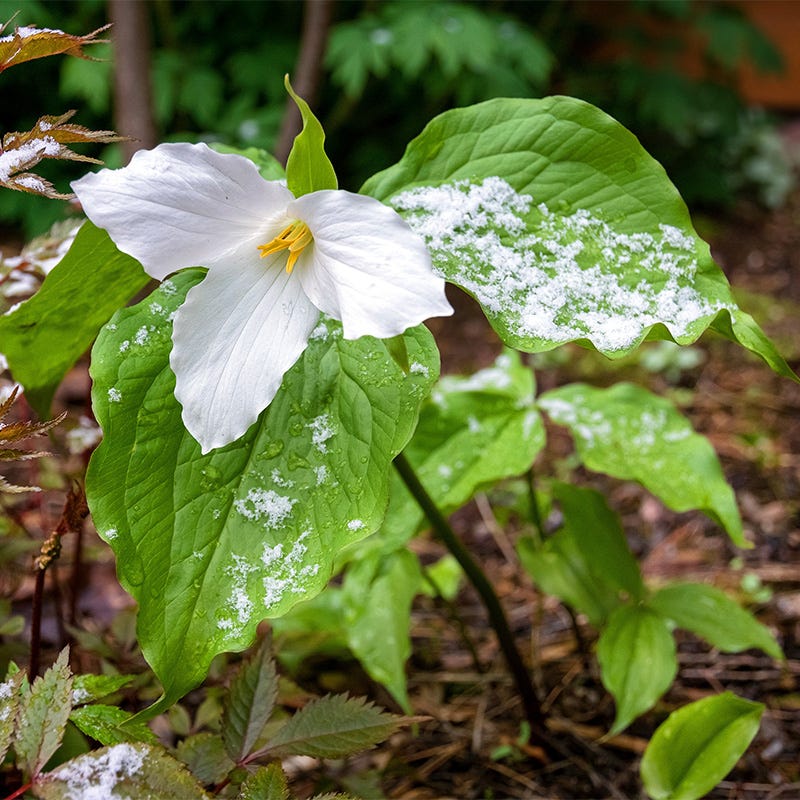
trillium flower seeds White TrilliumThis is the Big One. Not only in size, but also in popularity. This is always the gardeners favorite from the large trillium family, all prized wild garden flowers. The Great White or Snow Trillium opens exquisite blooms up to 4" across in mid spring, but that's not all. It has other wonderful qualities for gardeners, too. It is one of the very few plants in the flower kingdom which actually change color during bloom. After about a week or more, each
This is the Big One. Not only in size, but also in popularity. This is always the gardeners favorite from the large trillium family, all prized wild garden flowers. The Great White or Snow Trillium opens exquisite blooms up to 4" across in mid-spring, but that's not all. It has other wonderful qualities for gardeners, too. It is one of the very few plants in the flower kingdom which actually change color during bloom. After about a week or more, each flower slowly begins to change--from snow white to a shell pink. Then in a few days more, each pink one is a dark rose as the flower fades. This is one of the true spectacles of spring, and when a drift of this beautiful flower has blooms of both white and pink, it is unforgettable.A great companion plant is our yellow violet which blooms at exactly the same time. A bed of these Trilliums, yellow violets and a few unfurling ferns make a spring show that is truly breathtaking. Our trillium plants are nursery propagated from seed.
About the Great White Trillium There is great lore and legend about this plant, and also quite a bit of misinformation. Many people believe it is endangered which it is not. It may be protected in some places, but where it thrives, it grows in great abundance. It is the provincial flower of Ontario, and is quite common there and around the Great Lakes. It is also the official wildflower of Ohio. In New England, it is rare in all the states except Vermont, where it grows in huge drifts near Lake Champlain.
Unlike other Trilliums (such as the Red Trillium) which are solitary, standing alone in the woods, the Great White Trillium forms large drifts over the years, creating one of North Americas most beautiful spring wildflower displays.
Best of all, the Great White Trillium is quite easy to transplant and grow, making it a great choice for your wild garden.
The Trillium Tribe, and why its so famous. The classic 4-inch thick botanical reference work, Hortus Third, tells us that there are about 30 species of Trillium worldwide, but the majority of the species are native to North America. A very few originate in Japan and Korea, none in Europe. This is one reason that our colonists were so taken with these woodland beauties when they arrived. They had simply never seen anything like them.
Trilliums, as the name implies have everything in 3s--three leaves, three petals, etc. And compared to the other spring flowers that bloom when winter is finally over in our cold climates, the Trilliums are the ones with large look-at-me flowers. They were famous with the Indians before colonization, and instantly the stars of spring bloom with the colonists.
Remember, when the colonists arrived, they arrived on our east coast which was totally wooded--big, primeval old growth forest, right down to the beaches. And under these cathedral-like trees were the woodland native flowers--almost all species the Europeans had never seen. Also, this is why almost all the native flowers of our east coast are woodland plants, not meadow wildflowers. Of this famous original group of woodland wildflowers, which includes the Lady Slippers, Mayflower, Hepatica and many more, the Trilliums reigned supreme.
For centuries the flowers were picked heavily, which is unfortunate since a picked trillium is a dead trillium. But it was the clearing of the forests for farming, a necessity for the colonists, that really devastated the woodland wildflowers. We like to wring our hands about paving for interstates and new condominium projects today, but we needn't. The damage was done long ago when our ancestors cleared the eastern forests for farming. Of course, there are relatively small habitats left, and in recent years, our forested area has been enlarging, and woodland wildflower habitat has been restored in many places.
In any case, this elegant class of flowers, the Trilliums, are now recognized as precious and special, although they are not officially endangered. In many areas, Trilliums are still very common.
Wildflower gardeners love them, and it is true that most of them are not difficult to grow or transplant, and if conditions are good, they thrive. However, it does help to know the facts.
Here's how they are propagated. Trilliums such as The Great White spread very slowly by underground root stocks, and the seed produced creates new plants even more slowly. From a planted seed, it takes approximately five to nine years for a Trillium grandiflorum plant (the Great White Trillium) to bloom. So when you see a massive drift of these in spring, you know you're looking at a bunch of plants that are at least a decade old, probably much older. These plants are not daisies!
And how do they propagate themselves? Well, T. grandiflorum is one of the wildflowers whose seeds are distributed by ants. Yes, ants--not birds or bees, or the wind, but ants. This is why the species creates large close drifts over the years. Plants are never very far apart, since ants don't travel far. So each clump of T. grandiflorum you see was planted where you see it by an ant. (They carry the seeds away when they fall from the plant because the ants enjoy the sticky covering each seed case has when it falls to the ground.)
That brings us to the basic rarity of the Trilliums. A big factor is that each flower produces only one seed case when it fades. (Everybody knows that most flowers--a daisy, for example, produces hundreds of loose seeds from each flower.) So even if the ants find the sticky seed case, and take it underground where the several seeds inside can grow, there simply aren't huge numbers of white trillium seeds being planted each year. Other trillium species have various propagation strategies, but all take years and years.
Now you have some idea of the value of these beautiful plants. They are an important part of American botanical history, and deserve a place of honor in every American wildflower garden.
Here are the best known species, with a little info on each:
Trillium grandiflorum, Great White Trillium. The provincial flower of Ontario, and quite common there and around the Great Lakes. Also the official wildflower of Ohio, T. grandiflorum is native over most of the east, from Canada to Georgia, especially in neutral or non-acid soils. Large white flowers fade to pink; plants form large drifts.
Trillium erectum, Red Trillium. Also called Wake Robin and Stinking Benjamin, the second because of the flowers unpleasant odor, said to be similar to rotting meat. Propagated by flies. Red to purple flowers; plants solitary in acid or alkaline woods. Native to the eastern forests from Canada to Georgia.
Trillium undulatum, Painted Trillium. Smaller than the Great White or Red, but with one of the most beautiful flowers--white with purplish/red centers. Must have highly acidic soil; common in pine woods. Native to forests from Canada to Georgia.
Trillium Catesbaei, Rosy Trillium or Catesby Trillium. One of the first Trilliums discovered and named for Mark Catesby, the famous early British plant explorer and artist. The Rosy Trillium has somewhat smallish blooms which nod below the leaves. It is native to the Southeast, where Catesby visited.
Trillium viride var luteum, Yellow Trillium. This unusual trillium has mottled leaves and lemon yellow blooms that hold their petals high and never really open. It is often said to have a lemon scent, and is native from Kentucky south to Florida.
Trillium ovatum, Coast Trillium. This is a famous western trillium, much like T. grandiflorum in the east. Flowers are white, fading to pink. It is native from British Columbia through coastal forests all the way to central California.
Shipping Notes
- Free Standard Shipping on $100+ Orders to the USA.
- Except Preorder products are shipped in 48 hours.
- Delivery to the USA:
- Standard Shipping : 3-10 business days
- If time is of the essence, please consider selecting expedited delivery for faster service.
Exchange/Return Notes
- We offer a 30-day return/exchange service after receiving.
- Final sale items are not eligible for returns or exchanges.
- To process your return/exchange, please contact us at [email protected]
- Please click here for more details>>> Return & Exchange Policy