Pay in installments of $5.01 with
 ,
,
 and
and

Shipping Estimate
USA
- USA
- CAN
- USA
- CAN
Ships within 48 hours · Estimated delivery Jul 16 - Jul 21
 Promo Codes Available:
For Your Every Summer RSVP, with Code: SUMMER15
Description
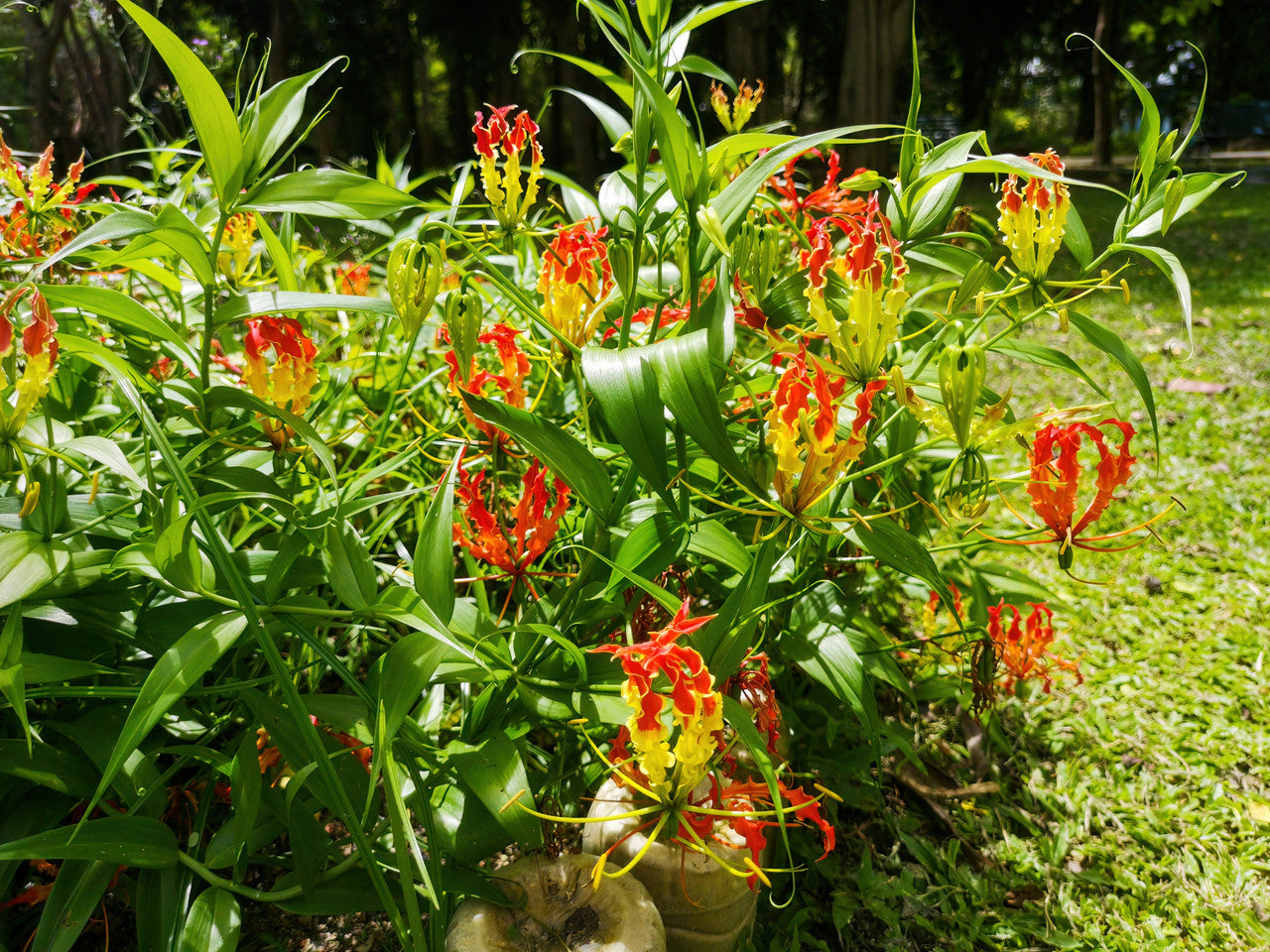
flame lily flower Gloriosa rothschildiana (Super Fire Lily)Gloriosa Lily: AKA Climbing flame lily, Fire lily, or Glory lily. The Gloriosa lily has many names, but no matter what you what you call it, it truly is a glory to behold. This summer bloomer in hot southern climates captures one's attention with its fiery red and yellow color. This bloom and vine add texture to your garden that offers a nice contrast to other summer growing plants. Often, we achieve this juxtaposition with form and color, and this
Gloriosa Lily: AKA Climbing flame lily, Fire lily, or Glory lily.
The Gloriosa lily has many names, but no matter what you what you call it, it truly is a glory to behold. This summer bloomer in hot southern climates captures one's attention with its fiery red and yellow color. This bloom and vine add texture to your garden that offers a nice contrast to other summer-growing plants. Often, we achieve this juxtaposition with form and color, and this bloom explodes with red, yellow, and even glossy dark green colors on unique vines. The fact that there are multiple blooms in varying stages for weeks makes every day an adventure.
Origin and Names: The Gloriosa lily isn't a lily at all. It isn't even from the lily family. It belongs to the Colchicaceae family. You may have heard this called: gloriosa lily, glory lily, fire lily, flame lily, climbing lily, creeping lily, cat’s claw or tiger’s claw. The Gloriosa lily comes in several colors, but the variety that we are carry is the Gloriosa rothschildiana. The name was given because the second baron Rothschild is credited with bringing this beauty to Europe from Africa.
Is it a tuber or a rhizome? Some call it rhizomatous tubers while others call it tuberous rhizomes. We will call it beautiful!
Care and Planting: Plant the tubers on their sides in well-drained soil about 2-4 inches deep. If you plant them on the deeper end, then the vines will be shorter. These tubers like to be moist but not wet. Because this is a vine, be sure to provide a trellis or fence. It will grow to 6 - 8 feet tall. Plant the tubers several inches away from the trellis so they have room to mature and multiply. Plant each tuber about 4-8 inches apart. Water the newly planted tubers daily until you see growth. Then you can reduce the watering to every couple of days. They like to receive the equivalent of about 1 inch a week.
Sunlight: Place the tubers where they will receive at least 6-8 hours of summer sun. Because they are a topical plant, they need the sun. If you are planting them in zone 8, they will work great in full sun to a little shade; however, due to the extreme temperatures in zones 9 and 10, they work best if given a break from direct sunlight late in the afternoon.
IN POTS: This beauty does great being placed in pots. Pots would allow someone in a colder zone to grow this summer-blooming beauty that could then be moved into a protected area during the winter. If you plant them in pots, you will need to water more frequently, but make sure that the pot has excellent drainage. The pots can be used indoors though not ideal for this sun-loving vine; however, you will need to make allowances for wintering your plant. Encourage its dormancy by watering it less often after it is done blooming in the late fall. Then in early spring simply start watering it and give it plenty of sunlight. By planting in pots, you are also able to "contain" the plant and place it where you want it each season. You may want to try a trellis on a porch one season, a fenceline another, or even place one near your mailbox for a splash of color. The tubers multiply so be sure to check your pots at the end of the season to see if you need to replant some into other pots.
Blooming: In the heat of July through fall, this bloom opens wide to show all her colorful glory. The blooms extend over a period of about four (4) weeks. The bloom hangs "upside down" and then begins the process of opening its six 2-3 inch long red and yellow tepals until they are completely reflexed (bending backwards until pointing upwards). Below the tepals are green stamen which add an even more unique look and color to this bloom. Some of the tepals are deep red and yellow while others on the same vine look almost pink. The colors often deepen the older the bloom becomes. That is why no two blooms are exactly the same. To encourage blooms and growth, you can add a light fertilizer to the plant monthly. The most common reason for not having successful blooms on the Gloriosa lily is from lack of sun. Too much fertilizer can encourage the plant to grow more foliage instead of blooms.
Vines: The Gloriosa lily is the only tuber/bulb that we carry that becomes a vine. We planted it in pots and in the ground against the fence. They aren't covering the fence, but they have added some beautiful greenery and pops of color to an otherwise ordinary line of sight. After the vine reaches several feet tall, it then begins to move horizontally as it produces the blooms which gives you multiple blooms up and down the fence line.
Cut Flowers: This tuber is super easy to grow and provides you with beautiful cut flowers. We cut a "grouping" (1 stem with 4 blooms) several days ago, and they look AMAZING in a vase! Can you imagine them with a whole vase full of other flowers and these peeking out here and there? Or even a vase full of nothing but these?
After Blooming/ Winter: As with most perennial bulbs, do NOT cut down the foliage as long as it is green. The foliage is sending nutrients to the bulb for future blooms. When the foliage dies back and is completely yellow, you can cut it off for the winter. In zone 8 and parts of 9, you may want to consider mulching over the tubers for the winter especially if they are away from your house as they won't curvive a hard freeze.
Other Interesting Facts:
All parts of this plant are toxic if ingested in large quantities, but especially the tubers. Small amounts though have been used in traditional medicine.
The flowers are deer and rabbit resistant.
However, it attracts pollinators like butterflies. This is all likely due to the vibrant colors of the bloom.
Shipping Notes
- Free Standard Shipping on $100+ Orders to the USA.
- Except Preorder products are shipped in 48 hours.
- Delivery to the USA:
- Standard Shipping : 3-10 business days
- If time is of the essence, please consider selecting expedited delivery for faster service.
Exchange/Return Notes
- We offer a 30-day return/exchange service after receiving.
- Final sale items are not eligible for returns or exchanges.
- To process your return/exchange, please contact us at [email protected]
- Please click here for more details>>> Return & Exchange Policy