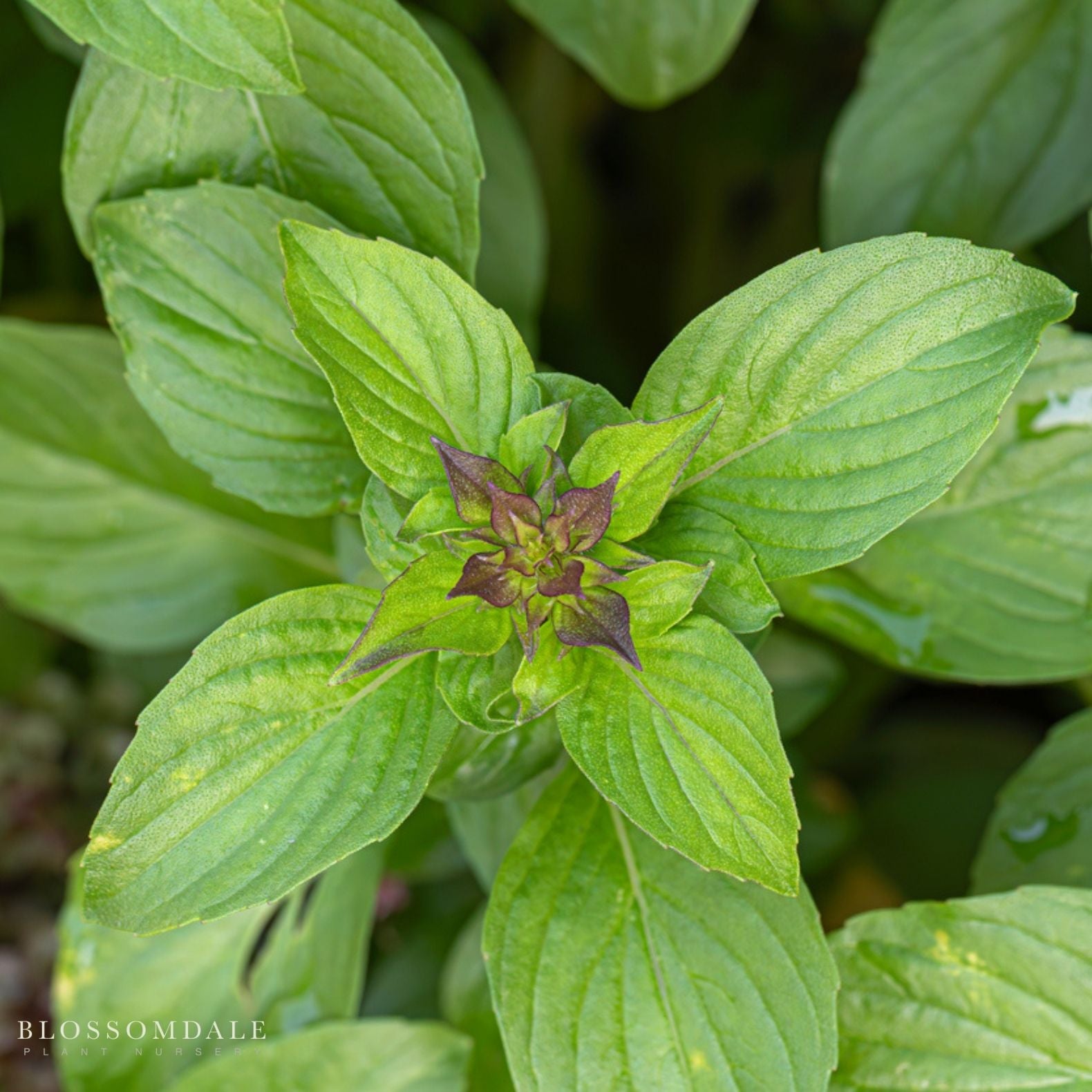
SKU: 8264020017
sabja seed plant

sabja seed plant Licorice Basil Seeds - licorice basil

Sale price$18.82 Regular price$20.91
Save 10%

Pay in installments of $5.23 with ShopPay, AfterPay and Klarna

Shipping Estimate
USA
  • USA
  • CAN

Ships within 48 hours · Estimated delivery Jul 16 - Jul 21

Promo Codes Available:

For Your Every Summer RSVP, with Code: SUMMER15

Description

sabja seed plant Licorice Basil Seeds - licorice basilOcimum basilicum Licorice Basil Ocimum basilicum Licorice Basil is a striking, aromatic annual herb, valued for its distinctive purple stems, dark green foliage, and bold, spicy anise flavor. Growing to about 12 to 24 inches tall with a spread of 12 to 18 inches, this variety is perfect for culinary herb gardens, ornamental borders, and container plantings where both flavor and visual contrast are desired. Unlike the mild sweetness of Genovese basil,

Ocimum basilicum Licorice Basil

Ocimum basilicum Licorice Basil is a striking, aromatic annual herb, valued for its distinctive purple stems, dark green foliage, and bold, spicy anise flavor. Growing to about 12 to 24 inches tall with a spread of 12 to 18 inches, this variety is perfect for culinary herb gardens, ornamental borders, and container plantings where both flavor and visual contrast are desired. Unlike the mild sweetness of Genovese basil, Licorice Basil offers a sharper, more intense profile similar to tarragon or fennel, filling the garden with a sweet, spicy scent that intensifies in the summer heat.


Culinary and Practical Uses

  • The sturdy, aromatic leaves are an essential component in Southeast Asian cuisine, providing the signature anise kick to Thai curries, Vietnamese pho, and stir-fries.
  • Excellent for infusing into syrups, cocktails, and herbal teas, where its natural sweetness and licorice notes add depth without the need for added sugar.
  • Traditionally used in herbal practices to settle the stomach, freshen breath, and as a natural insect repellent due to its strong essential oils.


Characteristics

  • Foliage: Narrow, dark green leaves with a purple flush and deep purple stems; possesses a strong, spicy licorice (anise) fragrance distinct from sweet basil.
  • Growth Habit: Upright, bushy, and vigorous; the sturdy stems make it less prone to flopping than other basil varieties and an excellent cut flower filler.
  • Flowers: Produces stunning, deep purple flower spikes (inflorescences) in late summer, which are highly ornamental and attract a multitude of pollinators.
  • Seeds: Harvested after the purple flower heads dry and turn brown; the small black seeds are easily collected and saved for the following season.


Growing Requirements

  • Sun: Thrives in full sun; requires at least 6 to 8 hours of direct sunlight to maintain its purple coloration and concentrated flavor oils.
  • Soil: Adapts to most soil types but prefers rich, fertile, well-draining soil with a pH between 6.0 and 7.5; warm soil is essential for germination.
  • Water: Requires moderate watering; keep the soil consistently moist but not waterlogged, as it is slightly more drought-tolerant than large-leaf sweet basils once established.
  • Spacing: Plant seeds or transplants 12 to 18 inches apart to allow for air circulation and accommodate its bushy growth.
  • Maintenance: Pinch off the growing tips frequently to encourage branching; while the flowers are beautiful, removing them prolongs the harvest window for culinary leaves.


Shipping Info

Licorice Basil seeds ship as fresh, high-quality, viable seeds that are carefully packaged for stability and protection from damage during transit. Prompt shipping supports reliable germination and seasonally appropriate planting.

Shipping Notes
  • Free Standard Shipping on $100+ Orders to the USA.
  • Except Preorder products are shipped in 48 hours.
  • Delivery to the USA:
  1. Standard Shipping : 3-10 business days
  • If time is of the essence, please consider selecting expedited delivery for faster service.
Exchange/Return Notes
  • We offer a 30-day return/exchange service after receiving.
  • Final sale items are not eligible for returns or exchanges.
  • To process your return/exchange, please contact us at [email protected]
  • Please click here for more details>>> Return & Exchange Policy
SKU: 8264020017

Discover Niche Categories That Outsell sabja seed plant

Top-Converting Item to Boost Your Average Order

4.3 ★★★★★
Based on 9 reviews
Sort
Highest Rating
Newest First
Oldest First
Product Reviews
J
Verified Purchase
Jeff Wade
Waukegan, US
★★★★★ 4
You don't have to like Justice Scalia to like his book.
Perhaps an appellate brief that you wrote would have been perfect if only the judge had read it. The lesson you learned, hopefully, was that there is no guarantee that a judge will read your brief. The lesson you can learn from "Making Your Case" is how to write so that the judges will read what you wrote - preferably before your oral argument. Writing in a quite candid, lucid and entertaining style, Scalia and Garner serve up tips that even the most experienced lawyers can learn from. If you find yourself approaching the court's word limit, for example, you may be minimizing the chances of having your brief read, as judges really do favor brevity. How do you write for a court that is notoriously dismissive of higher court precedents? How do you best respond to a judge who asks whether you would be content with a remand? These and other critical questions are addressed simply yet insightfully. If your legal education stressed the IRAC approach (Issue, Rule, Application, Conclusion), Scalia and Garner take you a step further by stressing a syllogistic approach. Even if you have already been exposed to all the best ideas about persuading appellate judges, you are still likely to gain much rom reading "Making Your Case" because the authors organize all those ideas in a way that makes them much easier to remember and keep them in mind as you prepare your written and oral arguments. Justice Scalia calls his approach to legal reasoning and argument "textualism," which I understand to mean that his decisions are driven by the language of the law and of the case. My impression from reading many of his decisions is that he is often driven by ideology, so I can't quite square his book with his decisions. I also question the book's fundamental statement that the overriding objective of a brief is to make the court's job easier, as I prefer to write primarily for the purpose of winning the case. My criticisms of "Making Your Case" are miniscule compared to those thrown at it by Richard Posner. But although I find Judge Posner's decisions generally more fair than those of Justice Scalia, I prefer the clarity of Justice Scalia's writing - especially when he teams up with Bryan Garmer. Judge Posner notwithstanding, Scalia and Garner have put together a gem that is likely to prove invaluable for law students as well as for trial and appellate lawyers who are still interested in improving their game. If you fall into either category, buy this book, read it two or three times, and then keep it handy as a reference. It should help you make your case.
WAS THIS REVIEW HELPFUL?YesReportShare
Reviewed in the United States on December 18, 2012
F
Verified Purchase
Fig&Friday
Battle Creek, US
★★★★★ 5
A Great Read... (for those in the legal field)
A great gift for those in the legal field. We ordered several for gifts throughout the year.. Made a great little gift basket with a bottle of whiskey :)
WAS THIS REVIEW HELPFUL?YesReportShare
Reviewed in the United States on January 20, 2026
R
Verified Purchase
rbnn
Los Angeles, US
★★★★★ 5
Elegant, useful
Simply the best book on legal persuasive writing ever written. Interesting, useful, fun, full of great anecdotes. Terrific discussion of statutory interpretation. Great references to scholarly classical treatises on rhetoric. This book is wonderful both for its analysis of oral argument and for its discussion of written forms of persuasion, like briefs. I wish I had had it earlier. My only complaint is the same one I have with virtually all modern style manuals: they advocate a simplistic prose style, characterized by short, conversational sentences, avoiding unusual words, eschewing Latin phrases. But I personally often find prose that breaks these rules a refreshing change. I enjoy reading a word or phrase I rarely see but that is perfectly chosen. And I enjoy learning new words or phrases. This book would condemn two of the greatest legal prose stylists out there: John Marshall and Learned Hand, both of whose opinions often contained sentences that would not work so well conversationally, that were full of long, convoluted sentences and classical allusions. My sense is that in this joint work Justice Scalia, who can write rich and interesting prose, pushed back against some of the simplifying strictures of his co-author. Furthermore, I think that often too much emphasis on simple words and sentences serves to make more complex ideas too difficult to express or to understand. Thus, the book (like most books) argues against "jargon," but jargon, once learned, is often a much clearer way of expressing something than a rephrasing. And the Roe v. Wade anecdote is great! It explains a lot... In any case, I am hardly qualified to criticize Justice Scalia, whose writing is far beyond my own. Anyway, this is a great book.
WAS THIS REVIEW HELPFUL?YesReportShare
Reviewed in the United States on May 7, 2008
W
Verified Purchase
WANDA LEE CATALAN
San Leandro, US
★★★★★ 5
Recomendado para todo estudiante de Derecho
Libro fácil de leer y fácil de comprender. Recomendado
WAS THIS REVIEW HELPFUL?YesReportShare
Reviewed in the United States on April 2, 2026
N
Verified Purchase
New York
Port Orchard, US
★★★★★ 5
Wonderful and useful book.
Format: Kindle
I am very glad I purchased this book. I used it over and over again. Wrote many notes and it added much value to pursue my cases at courts. This is a true asset for providing an overall overview with much advice. I also purchased his other book The Winning Brief, but that is only available in paper format and it is mainly for linguistic help in writing briefs for appellate court, for the purpose of really perfecting your writing. At lower courts or supreme courts you just do not have the time to think in that much details and these courts may not even read it. You are lucky if you can say two sentences on court appearances. They do not put that much into details when making judgments, so most likely your case ends up in the appellate, and here that book becomes valuable too - The Winning Brief. Again, this book really excellent and pleasant to read. The Kindle version was easy to search for anything, word, phrase, notes. 5 star book. THANKS.
WAS THIS REVIEW HELPFUL?YesReportShare
Reviewed in the United States on February 19, 2018

recommand products