SKU: 87523744456
mother succulent

mother succulent Mother of Thousands Plant 'Kalanchoe laetivirens' 4" Pot

Sale price$20.44 Regular price$22.71
Save 10%

Shipping Estimate
USA
  • USA
  • CAN

Ships within 48 hours · Estimated delivery Jul 15 - Jul 20

Promo Codes Available:

For Your Every Summer RSVP, with Code: SUMMER15

Description

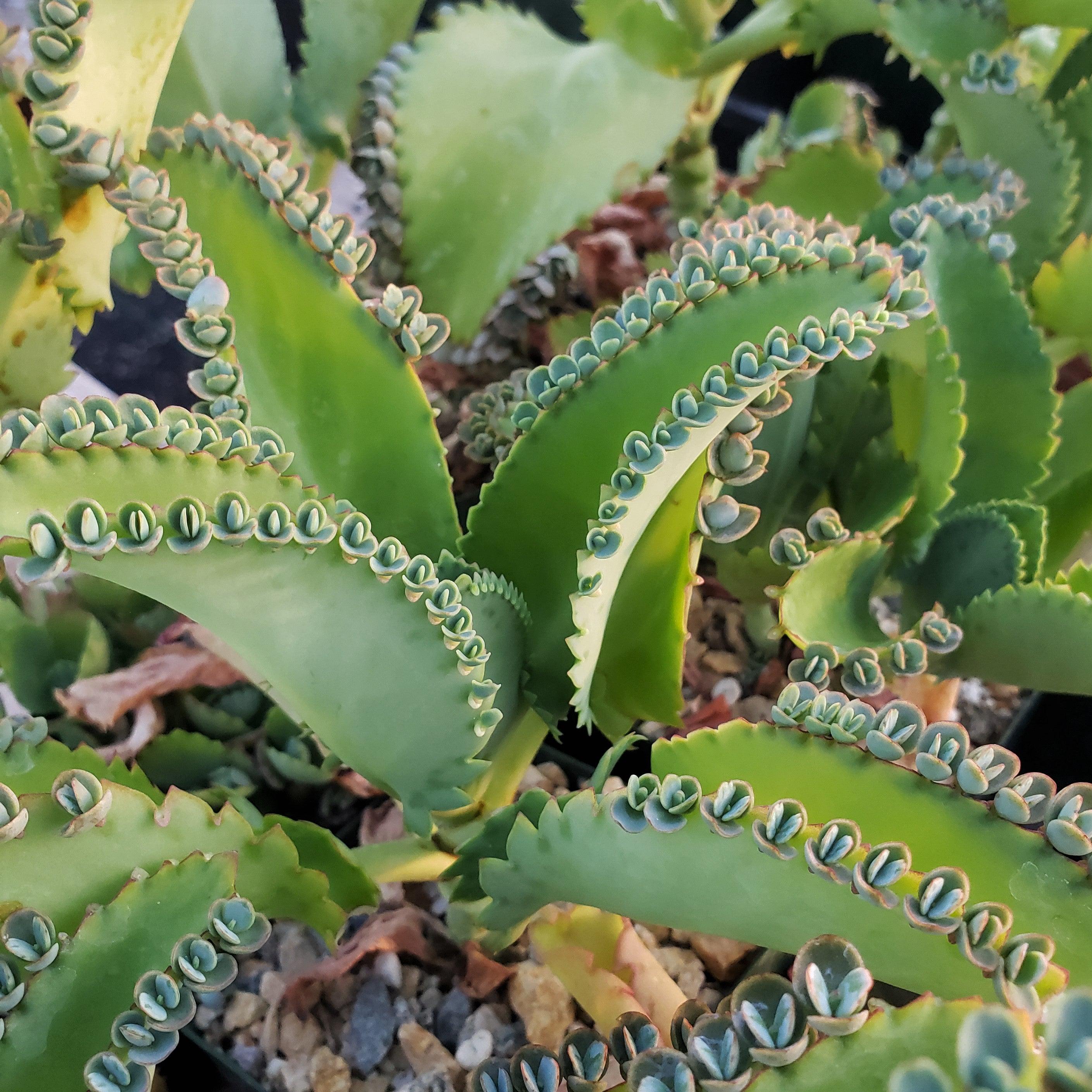
mother succulent Mother of Thousands Plant 'Kalanchoe laetivirens' 4" PotIntroducing the mother of thousands plants, scientifically known as Kalanchoe laetivirens, is a fascinating succulent from the Kalanchoe genus that is native to Madagascar. It has several other common names, such as Alligator Plant, Mexican Hat Plant, and Devil's Backbone. However, the true Mother of Thousands is Kalanchoe daigremontiana, which can be identified by the distinctive purplish brown markings on the undersides of its leaves. The mother of

Introducing the mother of thousands plants, scientifically known as Kalanchoe laetivirens, is a fascinating succulent from the Kalanchoe genus that is native to Madagascar. It has several other common names, such as Alligator Plant, Mexican Hat Plant, and Devil's Backbone. However, the true Mother of Thousands is Kalanchoe daigremontiana, which can be identified by the distinctive purplish-brown markings on the undersides of its leaves.

The mother of thousands gets its name from its unique ability to produce a lot of plantlets along the edges of its leaves. These plantlets, also known as "baby plantlets" or "pups," are miniature versions of the mother plant and can easily drop off and take root in the surrounding soil, giving rise to new plants.  

Most people confuse the Kalanchoe plants because of their similarities, but the name "mother of thousands" (Kalanchoe laetivirens) refers to the tiny plantlets that develop along the edges of its leaves, whereas "mother of millions" (Kalanchoe delagoensis) produces plantlets on the tips of its leaves. There's even a hybrid called Kalanchoe houghtonii that combines the features of both plants. It's like a wonderful Kalanchoe family reunion! 

The leaves of this monocarpic mother-of-thousand plant are thick and fleshy, with an attractive grayish-green color. They are often adorned with small, reddish-brown spots or markings, adding to the Kalanchoe plant's visual appeal. The mother-of-thousand succulent has an upright growth habit and can reach a height of up to 3 feet, making it a striking addition to any indoor or outdoor space. 

The flowers of the mother of thousands plants are small, tubular, and bell-shaped. They are typically pinkish-grey in color and can appear in clusters on tall stalks. The flowering season for this mother-of-thousand plant is usually in late winter or early spring, and the flowers can last for several weeks. When grown indoors, it rarely blooms. 

Mothers of thousands are considered to be mildly toxic to pets and humans if ingested. It contains compounds that can cause gastrointestinal discomfort. It's always best to keep it out of reach of curious pets and children. 

You can propagate your alligator plant through its small plantlets. Pick two or three plantlets from the leaves and propagate them properly. The plant does not require any pruning other than the removal of dead stalks and dropped plantlets. It's like a little plant factory!  

It's worth noting that while the Kalanchoe daigremontiana mother-of-thousand plant can be a delightful addition to your plant collection, it can also be considered invasive in some regions. The plantlets it produces can spread easily and take over if not properly managed. So, if you decide to grow this plant, it's important to be mindful of its potential to become invasive and take appropriate measures to control its growth.

When and How to Water Your Mother of Thousands Plant

Just like its closely related Kalanchoe plant, the mother of millions, this succulent is also adapted to arid conditions and is drought tolerant. Mother of thousands needs water at room temperature. Extreme cold or freezing temperatures or extremely hot water damages the roots of your Kalanchoe laetivirens. 

To keep your mother of thousands happy, allow the soil to dry out completely between waterings. Stick your finger about an inch into the soil, and if it feels dry, then it's time to give it a good drink. Remember to use well-drained soil and a pot with good drainage and holes to prevent water from pooling and causing root rot. 

During the cooler months or when the plant is in a dormant phase, you can reduce the frequency of watering even further. These succulents are built to store water in their leaves, so they can handle dry spells better than excessive moisture. 

Light Requirements - Where to Place Your Mother of Thousands Plant 

The mother of thousands loves bright, indirect sunlight. It thrives in a spot where it can soak up plenty of light throughout 4-6 hours of the day. Find a sunny east-facing window or a well-lit area in your home for your Kalanchoe mother-of-thousand succulent to bask in the sunshine. 

However, be careful not to expose the mother of thousands to direct sunlight for extended periods, as it can scorch its leaves. So, a balance of bright, indirect light is ideal for this plant's growth and health. 

Remember, finding the right lighting conditions will help your mother-of-thousand plant flourish and showcase its unique characteristics! 

Optimal Soil & Fertilizers

When it comes to the soil and fertilizer needs of the mother-of-thousand plant, here's what you need to know!

For soil, the mother of thousands prefers well-draining potting soil that allows excess water to flow away. Instead of using the peat-moss-based soil, make or buy a well-draining potting mix, or ideally use our specialized succulent potting mix that contains 5 natural substrates and mycorrhizae to promote the development of a strong root system that helps your succulent to thrive. 

As for fertilizing, the mother of thousands doesn't require frequent feeding. You can use a balanced, natural NPK fertilizer with an equal ratio of about (5-10-5) during the growing season, which is typically spring. 

Remember, it's always best to under-fertilize rather than over-fertilize succulents like the mother of thousands. Too much fertilizer can cause salt buildup and harm the plant. So, a light feeding every few months should be sufficient to keep your plant happy and thriving! 

Hardiness Zone & More 

Typically grown in hot, arid desert regions, the Mother of Thousands plants thrive indoors in warm, dry surroundings. Only in hotter climates, such as Florida and Hawaii, can the slow-growing mother of thousands be grown outside. 

If you live in USDA regions 9 to 11, you can also grow this particular plant outdoors year-round, but they are not frost-tolerant, so you should plant them indoors or put them in a pot and move them indoors during the winter if you live outside of these regions.

Keep your Kalanchoe laetivirens away from cold, drafty windows and air vents if you are growing it indoors in a cold climate. 

As for humidity, this Kalanchoe mother-of-thousands succulent grows wherever it can tolerate a range of levels, but it's important to provide good air circulation.

While household humidity is generally good enough, these mother-of-thousand succulents will do even better with some extra moisture in the air. Set up a humidifier nearby or grow them in naturally humid rooms like your bathroom or kitchen. 

The Bottom Line

Give it a try and enjoy the beauty and intrigue this unique Kalanchoe laetivirens mother of thousands brings to your home or garden! You can find out more information about the difference between the Mothers of Thousands and the Mothers of Millions right here on Planet Desert. 

Shipping Notes
  • Free Standard Shipping on $100+ Orders to the USA.
  • Except Preorder products are shipped in 48 hours.
  • Delivery to the USA:
  1. Standard Shipping : 3-10 business days
  • If time is of the essence, please consider selecting expedited delivery for faster service.
Exchange/Return Notes
  • We offer a 30-day return/exchange service after receiving.
  • Final sale items are not eligible for returns or exchanges.
  • To process your return/exchange, please contact us at [email protected]
  • Please click here for more details>>> Return & Exchange Policy
SKU: 87523744456

Discover Niche Categories That Outsell mother succulent

Top-Converting Item to Boost Your Average Order

4.4 ★★★★★
Based on 1433 reviews
Sort
Highest Rating
Newest First
Oldest First
Product Reviews
M
Verified Purchase
Manuel Hinds
Grantham, US
★★★★★ 5
A distant mirror of our current problems
Format: Hardcover
The title of this excellent book accurately describes its contents:it is about a battle fought to define a new world order, that which was emerging from the ashes of World War II. The book also conveys the messy complexity of such a historical process--how individual characters interpreted the events around them, realized that they were giving shape to a radically new future, tried to take advantage of them to advance their own personal and national interests, and succeeded in accordance with their intelligence, the cunning of their argumentation, and, above all, the shifts in the real power that supported them. Masterly, Benn Steil makes the reader feel how Keynes and White gradually reached an unspoken and unrecognized agreement regarding the shape that the new world would have, and then fought to gain advantage in that new world--Keynes trying to keep the British Empire paramount in the world order, now based not on the Royal Navy but on Britain's alliance with the United States, the emerging superpower, and White asserting the unimpeded power of the United States. Focusing on one crucial aspect of the new order, money, Steil is able to reenact the human drama of the transfer of world power from Britain to the United States in all orders of life. It is an excellent history book. The book, however, goes beyond history as the narration and understanding of past events. When reading it, there is an eerie feeling that you are reading about current events. The process that led to Bretton Woods started thirty years before, with World War I and the end of the classical gold standard. When the war ended, a new monetary system was created, which was called the gold exchange standard. It resembled but emasculated the power of the old gold standard to keep monetary order in the world at large. This new system gave central banks the power to create money independently of the international consequences of doing it. With time, central banks abused this power, created a boom in the 1920s and then a depression in the 1930s. Bretton Woods was convened to reintroduce order in the monetary world. Like the gold standard of old, the new system created there was tied to gold in an effort to ensure stability. Yet, it also allowed central banks freedom to create money under certain circumstances. As it happened in the 1920s and 1930s, central banks abused their power, blew up the international system (in this case the Bretton Woods system) and then led the world into a series of booms and busts that has not ended as yet. A new monetary order will be needed to avoid worldwide inflation and protracted recessions. To understand the issues that will be crucial to give shape to this new monetary order it will be necessary to revisit the making of Bretton Woods in detail. There is no better way to understand these issues that Ben Steil's The Battle of Bretton Woods. Thus, in addition to being an excellent history book, it is also an excellent book about current events. Full disclosure: I wrote a previous book with Benn Steil: Money, Markets and Sovereignty (Yale University Press, 2009).
WAS THIS REVIEW HELPFUL?YesReportShare
Reviewed in the United States on May 28, 2013
D
Verified Purchase
djwatkins487
New York, US
★★★★★ 5
The Battle of Bretton Woods
Format: Hardcover
From the growing reliance upon international finance and the devastating repercussions of two World Wars, Steil weaves together an important narrative that tells the story of America's rise to the world stage as a major power. Britain's reign of dominance comes to an abrupt end under the weight of the Second World War and the dependence of their territories. Reliance on foreign aid and mounting debt put Britain in a precarious situation for which the United States capitalized on to secure its place as the dominant world power. Through the ideas and experiences of two brilliant economists, Harry White and John Keynes, were guided through the creation and implementation of an economic solution to remedy, and further amalgamate the global financial framework. At Bretton Woods, White and Keynes promote slightly different plans that form the International Monetary Fund and World Bank; organizations designed to monitor, stabilize, and assist international finance. To Britain, and much of the world's chagrin, the organizations are formed in a manner that benefited the United States post-World War Two position as a creditor nation. Dollar dominance in the newly designed financial markets promotes short-term growth for the United States. However, financial mismanagement and over-extension soon lead the U.S. down a path of monetary hardship that ultimately results in our current situation as debtor nations (much like Britain was when the story began). The author ends the narrative by chronicling the effects of Bretton Woods on the United States, Britain, and international finance from the mid-twentieth century to the present. This book tells the remarkable story of America's rise to power through a financial lens. Steil is a wonderful writer who describes complex ideas of monetary policy, international economics, and currency manipulation in such a manner that is easy to understand and leaves the reader wanting more.
WAS THIS REVIEW HELPFUL?YesReportShare
Reviewed in the United States on August 16, 2013
A
Verified Purchase
Alfred H.
Battle Creek, US
★★★★★ 5
A concise, readable history of European developments prior to W.W. i.
Format: Paperback
This is part of a 4 volume series on (primarily) European history covering the development of the French and Industrial revolution(s) with particular emphasis on the Belle Epoque that marked the end of nearly 100 years of peace among the European Powers. It covers a variety of topics ranging from the emergence of the working classes; the role of the middle class; industrial capitalism; nationalism; the sciences and the arts; and, even a chapter on the "New Woman". Quite encompassing in its treatment and its analysis of the a period that serves as a background to the twentieth century.
WAS THIS REVIEW HELPFUL?YesReportShare
Reviewed in the United States on August 3, 2018
J
Verified Purchase
Juan Manuel Wills
Lowell, US
★★★★★ 5
Un comentario
Format: Paperback
El mundo burgués generó desarrollos muy importantes para los habitantes de Europa Occidental particularmente; incrementó de manera importante los niveles de vida de una porción significativa de la sociedad, introdujo innovaciones claras en las ciencias, en lo educativo, en el comercio global y en el intercambio entre diferentes culturas. Mejoró la productividad, las comunicaciones, la alimentación......Pero también incorporó consigo tendencias negativas y difíciles que cambiaron para siempre la interrelación entre pares al crearse una diferencia significativa de clases, la alta, burguesa y la trabajadora y proletaria, continuó la discriminación sobre la campesina, estableció el concepto forzado de nacionalismo, transformó a los países mas desarrollados en imperios con ansias de crecimiento y de dominio de los menos preparados, se evidenció la explotación del tercer mundo, se inició el armamentismo y la instigación a la guerra que culminó con la desastrosa confrontación de 1914. El mundo, a partir de ese momento no volverá a ser igual. Todos estos conceptos, esta historia, están amenamente descritos por el autor, con un gran conocimiento de la época y con una inteligente asociación de los acontecimientos para hacer entender al lector sus grandes transformaciones e implicaciones. Como los otros tres libros de la serie, lo recomiendo ampliamente. Permite entender todo la evolución de nuestra civilización en los dos últimos siglos así como la influencia generada por los grandes imperios de la época y sus pensadores
WAS THIS REVIEW HELPFUL?YesReportShare
Reviewed in the United States on November 28, 2011
P
Verified Purchase
Peyman ADL DOUSTI HAGH
Lexington, US
★★★★★ 5
This is a good book to read and understand how the European nations ...
Format: Paperback
This is a good book to read and understand how the European nations deployed their armies around the world to extract natural resources from other nations. Now, we have developing and underdeveloped nations.
WAS THIS REVIEW HELPFUL?YesReportShare
Reviewed in the United States on October 1, 2017

recommand products