Pay in installments of $6.45 with
 ,
,
 and
and

Shipping Estimate
USA
- USA
- CAN
- USA
- CAN
Ships within 48 hours · Estimated delivery Aug 10 - Aug 15
 Promo Codes Available:
For Your Every Summer RSVP, with Code: SUMMER15
Description
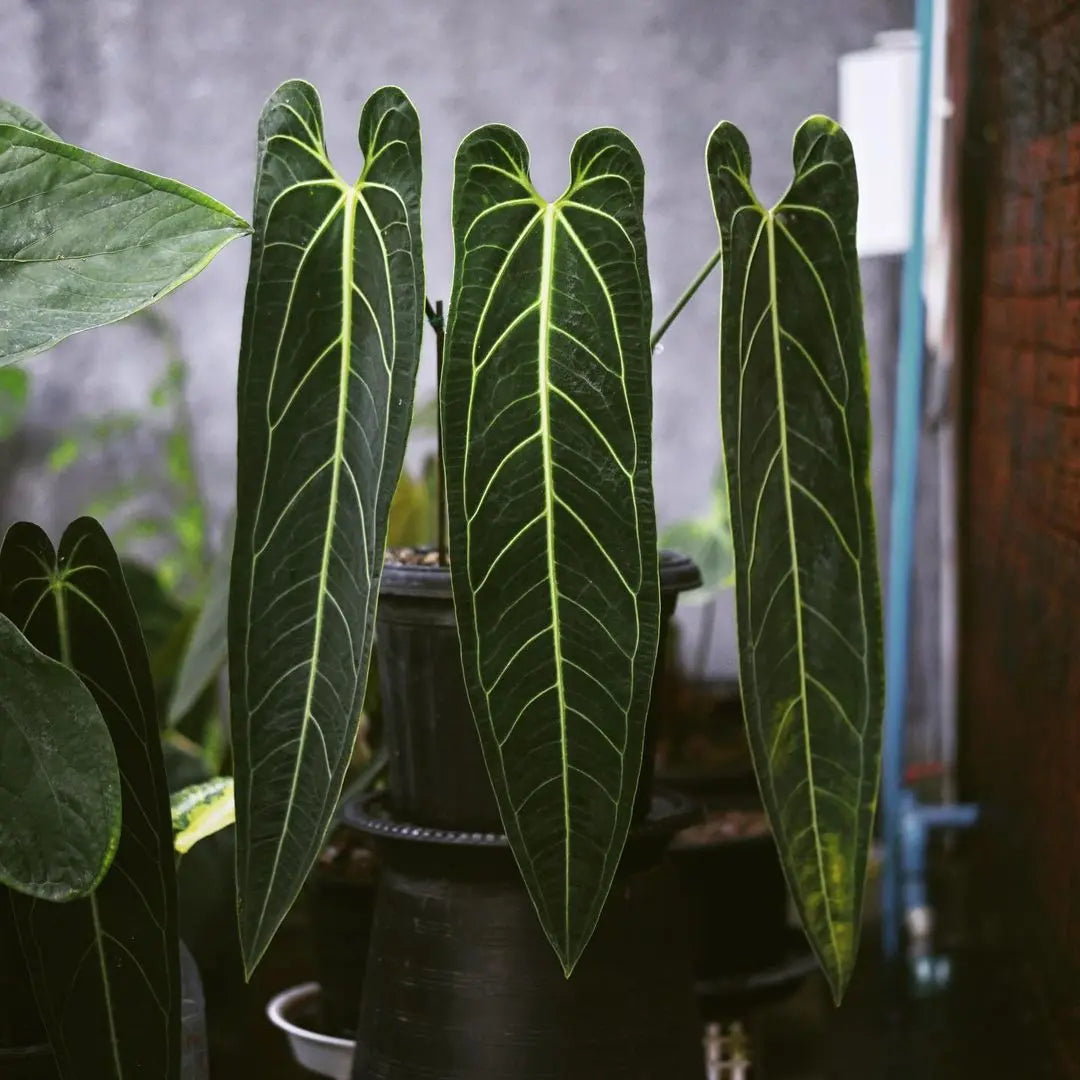
anthurium warocqueanum dark narrow form Anthurium Queen Warocqueanum 'Dark Narrow' – SoiledIf the Anthurium veitchii is the King, then Anthurium warocqueanum is unquestionably the Queen and the 'Dark Narrow' form is the Queen at her most regal. Native to the rainforests of Colombia and named to honour Belgian industrialist and plant collector M. Warocqu, this epiphytic aroid produces pendant, velvety leaves that hang downward in long, narrow arcs reaching 90120 cm at maturity deep near black green in colour, each one traced with a fine
If the Anthurium veitchii is the King, then Anthurium warocqueanum is unquestionably the Queen — and the 'Dark Narrow' form is the Queen at her most regal. Native to the rainforests of Colombia and named to honour Belgian industrialist and plant collector M. Warocqué, this epiphytic aroid produces pendant, velvety leaves that hang downward in long, narrow arcs — reaching 90–120 cm at maturity — deep near-black-green in colour, each one traced with a fine network of silver-white veins that gleam against the dark surface like threads of light through silk. The 'Dark Narrow' designation refers to the collector-selected ecotype with the deepest, most saturated leaf colour, narrower and more elongated leaf form, and fewer but more dramatically defined veins compared to the broader, greener standard form. A member of the Cardiolonchium section — the velvet-leaved royalty of the Anthurium genus — it is one of the most coveted aroids in the world.
Light
▾
Bright indirect light — 6–8 hours daily, but never direct sun. An east-facing window or 1–2 m from a filtered south-facing window is ideal. The 'Dark Narrow' form's deep colouration is most vivid in bright indirect light — in lower light leaves trend greener and growth slows significantly. A quality grow light at 12–14 hours is an excellent solution and produces some of the most impressive leaf development. No morning or late evening direct sun on the velvety surface — even gentle direct sun scorches the leaves.
Watering
▾
Keep the substrate barely moist — allow the top 3–4 cm to approach dryness, then water thoroughly. In chunky mix this means checking every 5–7 days. The roots need excellent airflow and will rot rapidly in saturated substrate. Use filtered or rainwater at room temperature. Never let the pot sit in standing water. Reduce slightly in winter but never allow to fully dry. This is a heavier drinker than most aroids — do not underwater.
Humidity
▾
70–85% — the single most critical factor for sustained health and long leaf development. A humidifier running nearby is strongly recommended. Crucially, pair high humidity with good air circulation — stagnant humid air is as damaging as dry air. A gentle fan on low, directed away from the plant but circulating the room, provides the airflow the leaves need. Never mist directly onto the velvety surface.
Growing Media
▾
Chunky, extremely well-aerated epiphytic mix — 40% orchid bark, 30% perlite, 20% sphagnum moss, 10% coco coir. Or 100% sphagnum moss kept barely moist. pH 5.5–6.5. Shallow wide pot or hanging basket. The entire stem can be packed in damp sphagnum to encourage aerial root development along its length. Repot every 2 years in spring — do not disturb roots unnecessarily. Can also be grown on an epiphytic mount.
Feeding
▾
A heavy feeder compared to most aroids — balanced liquid fertilizer at half strength every 3–4 weeks in spring and summer. An extended-release fertilizer applied at half label strength every 3 months is an excellent low-maintenance alternative. Apply only to moist substrate. Flush thoroughly every 2–3 months to prevent salt build-up. Stop feeding in winter.
Dropping One Leaf for Every New One — No Progress
▾
The Queen's distress signal. Review all four factors simultaneously: light (too low?), humidity (below 70%?), temperature (below 20°C at night?), and watering (inconsistent?). Usually one is the culprit — improve all four and the cycle breaks within 1–2 leaf cycles. Do not repot during this phase; root disturbance compounds stress.
Brown Circles with Yellow Halo on Leaves
▾
Bacterial leaf spot — caused by water sitting on the velvety leaf surface. Remove affected leaves with clean scissors. Improve air circulation immediately, stop all misting, and ensure humidity comes from a humidifier rather than direct water. Existing spots are permanent; new growth will be clean in improved conditions.
Brown Crispy Leaf Tips or Edges
▾
Low humidity, proximity to an AC vent or fan, or underwatering. Boost humidity to 70%+, move away from drying air sources, and check that the substrate is not drying out fully between waterings. Trim existing brown tips neatly — they will not recover.
Leaves Getting Greener, Less Dark
▾
The 'Dark Narrow' colouration deepens in bright indirect light and diminishes in low light. Move to a brighter position or add a grow light. The deep near-black-green is most vivid at the right light level — too little and the leaves trend olive-green; too much direct sun and they bleach.
Root Rot — Yellow Leaves, Soft Stem Base
▾
Overwatering or substrate staying saturated too long. Unpot immediately, trim all black and mushy roots with clean scissors, allow to air-dry for a few hours, then repot in fresh chunky mix. Water much less going forward — the roots need to breathe between waterings.
📋 Quick Plant Profile
| Botanical Name | Anthurium warocqueanum T.Moore 'Dark Narrow' |
| Named After | M. Warocqué — Belgian industrialist and plant collector |
| Common Name | Queen Anthurium — paired with A. veitchii, the King Anthurium |
| Section | Cardiolonchium — the velvet-leaved group; includes A. crystallinum and A. magnificum |
| Family | Araceae |
| Origin | Colombia; epiphytic in tropical rainforest |
| 'Dark Narrow' Form | Near-black-green colouration; narrow elongated leaves; fewer but more defined silver veins vs. standard form |
| Mature Leaf Length | 90–120 cm; pendant, hanging downward; cardboard-thick and velvety |
| Health Metric | Leaf count accumulates on a happy plant; cycling (losing one per new one) = distress signal |
| Light | Bright indirect; 6–8 hours; grow light excellent; no direct sun |
| Watering | Top 3–4 cm approaching dry; filtered water; heavier drinker than most aroids; no standing water |
| Humidity | 70–85%; humidifier essential; strong air circulation alongside; never mist leaves directly |
| Temperature | 20°C–30°C; cold-sensitive; nighttime minimum 18°C critical |
| Soil | Chunky epiphytic mix or 100% sphagnum moss; pH 5.5–6.5; shallow wide pot or hanging basket |
| Feeding | Heavy feeder — every 3–4 weeks in growing season; extended-release alternative every 3 months |
| Do Not Mist | Water on velvety leaves causes bacterial leaf spot — use humidifier only |
| Ideal For | Serious Collectors, Hanging Displays, Grow Tents, Bright Humid Rooms |
| Care Level | Advanced — humidity, air circulation, and consistent warmth are the three pillars |
Shipping Notes
- Free Standard Shipping on $100+ Orders to the USA.
- Except Preorder products are shipped in 48 hours.
- Delivery to the USA:
- Standard Shipping : 3-10 business days
- If time is of the essence, please consider selecting expedited delivery for faster service.
Exchange/Return Notes
- We offer a 30-day return/exchange service after receiving.
- Final sale items are not eligible for returns or exchanges.
- To process your return/exchange, please contact us at [email protected]
- Please click here for more details>>> Return & Exchange Policy