Pay in installments of $6.11 with
 ,
,
 and
and

Shipping Estimate
USA
- USA
- CAN
- USA
- CAN
Ships within 48 hours · Estimated delivery Sep 4 - Sep 9
 Promo Codes Available:
For Your Every Summer RSVP, with Code: SUMMER15
Description
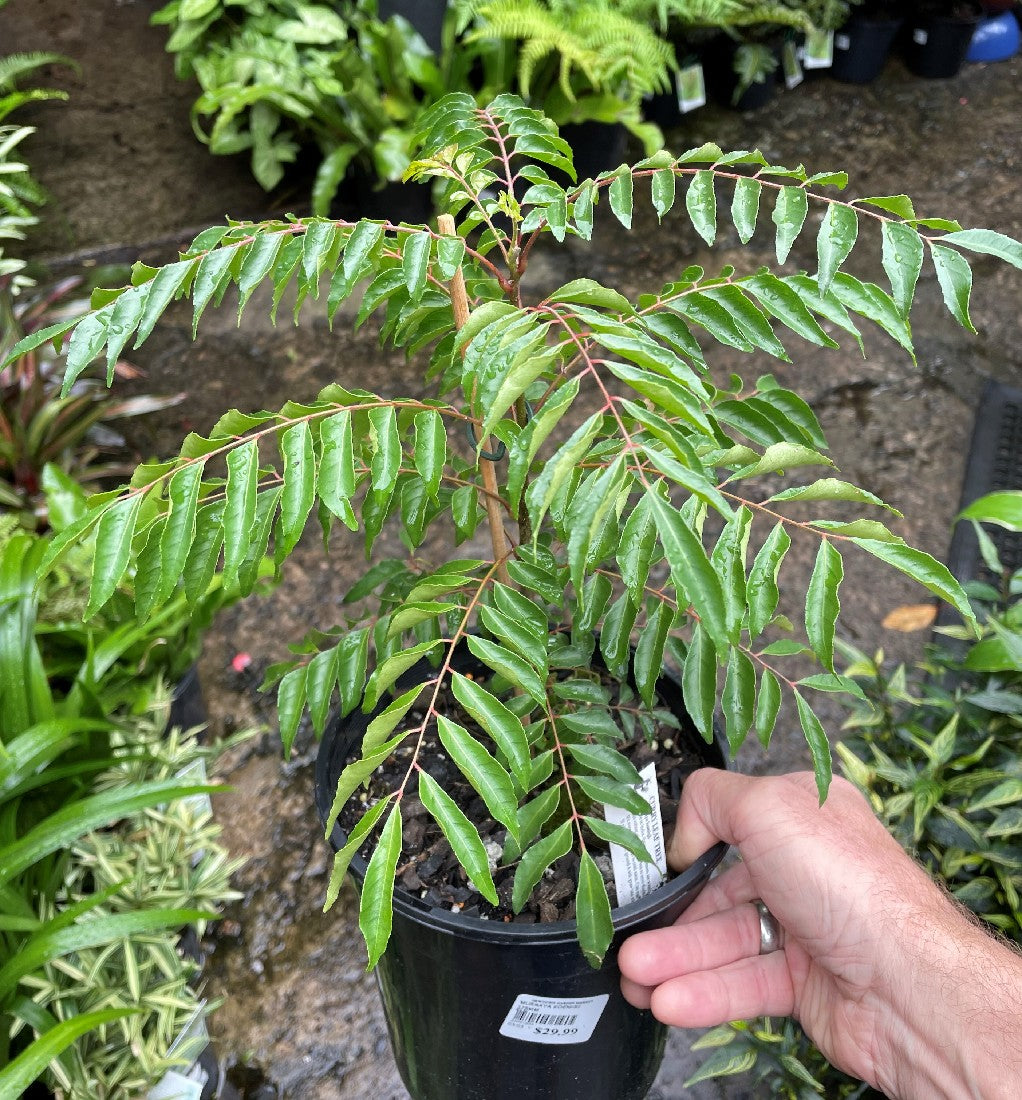
curry leaf plant in a pot Curry Leaf TreeCurry Leaf Tree The Curry Leaf Tree (Murraya koenigii) is a small evergreen tree. It is part of the Rutaceae family and is native to India and Sri Lanka. The Curry Leaf Tree has a spreading and rounded habit which has foliage that is mid green and fern like in appearance. The leaves are highly aromatic and used in many Indian dishes. During Spring and Summer the tree produces clusters of small fragrant creamy white flowers. The Curry Leaf Tree can
Curry Leaf TreeThe Curry Leaf Tree (Murraya koenigii) is a small evergreen tree. It is part of the Rutaceae family and is native to India and Sri Lanka. The Curry Leaf Tree has a spreading and rounded habit which has foliage that is mid-green and fern like in appearance. The leaves are highly aromatic and used in many Indian dishes. During Spring and Summer the tree produces clusters of small fragrant creamy white flowers. The Curry Leaf Tree can self pollinate so after the flowers small black berry like fruit forms. The berries also contain a single large seed which is toxic and should not be eaten. The Curry Leaf Tree is a tropical to subtropical tree but does well in temperate areas and requires rich well drained soil in a warm sheltered position in the garden. When growing in colder climates keep it in a large container and move it to a warm position in Winter. They are frost tender.
Benefits of Growing Curry Leaf Tree
They are ideal in a scented garden both for their scented leaves and flowers. They can also be used for screening or as an ornamental tree. The leaves are used in Indian cooking and will keep for up to a week if kept in a dry plastic bag in the fridge. To preserve them for longer periods, pick curry leaf leaves when they are green and full of flavour and freeze them, keep the leaves intact before freezing them.
Climatic Zones
Temperate to tropical.
Plant Size
Height: 2-4m, Width: 2-4m
Soil Preparation
Prefers well drained soils but will adapt to most soil conditions.
How To Plant Curry Leaf Tree
Plant in full sun to part shade, with the plant crown at soil level.
If planting in a cold climate try growing it against a north or west facing wall, which creates a warm microclimate. Other wise planting it in a pot with good quality potting mix and moving it to a warm position over Winter.
Shipping Notes
- Free Standard Shipping on $100+ Orders to the USA.
- Except Preorder products are shipped in 48 hours.
- Delivery to the USA:
- Standard Shipping : 3-10 business days
- If time is of the essence, please consider selecting expedited delivery for faster service.
Exchange/Return Notes
- We offer a 30-day return/exchange service after receiving.
- Final sale items are not eligible for returns or exchanges.
- To process your return/exchange, please contact us at [email protected]
- Please click here for more details>>> Return & Exchange Policy
4.1 ★★★★★
Based on 10 reviews
Sort
Product Reviews
★★★★★ 4
A good read
Format: Kindle
Multiple points of view. 3 Alpha men and an Omega male. She is a Beta in training for a new program placing betas in Alpha/Omega packs. Mila is only doing the program for the money to take care of her dad. She wasn't expecting to fall for a pack but when she sees this packs Omega she is done for. There is just something about him. His Alphas are good looking as well. Too bad she is hiding a secret and their government is acting shady. I liked it and can't wait to see where their story goes.
WAS THIS REVIEW HELPFUL?YesReportShare
Reviewed in the United States on November 14, 2023
★★★★★ 3
Slightly repetitive but I did love some things
Format: Kindle
I love this type of story. And omegaverse is one of my all time favorite genres. But there are a few things that pulled me out of my enjoyment while I was reading. It was repetitive at times as well as struggled with telling not showing. So we didn’t always feel like we were experiencing things with the main character. There were also some plot holes but they may still be answered in part 2.
Now this isn’t to be said I didn’t enjoy parts of the story. I loved the almost instant love between Mila and Oliver. And how he started changing around her.
WAS THIS REVIEW HELPFUL?YesReportShare
Reviewed in the United States on February 15, 2024
★★★★★ 5
delightful read
Format: Kindle
What a delightful read. The characters are awesome, the plot was so good, I loved it. I was intrigued and it kept me wanting more. Told in multiple pov, the book sucks you in and doesn’t let go. I cannot wait to read the next book.
WAS THIS REVIEW HELPFUL?YesReportShare
Reviewed in the United States on January 30, 2025
★★★★★ 4
not bad
Format: Kindle
I loved the plot of this book. The characters just didn’t have a lot of depth. The connections and “love” just weren’t communicated very well in the writing. The author didn’t write the sweet psycho trope very well at all either. Lachlan was just a mess of a character.
WAS THIS REVIEW HELPFUL?YesReportShare
Reviewed in the United States on November 17, 2023
★★★★★ 5
A Beta Worth Rooting For
Format: Kindle
In Spare, Violet Fox flips the omegaverse on its head, giving us a Beta heroine determined to make her mark. Joining the Beta Trials to support her sick father, she's thrown into a pack that doesn't want her, especially the possessive Alphas.
But here's the twist: their sweet Omega turns out to be her scent match. Cue the angst, forbidden tension, and a slow-burn romance that will make your heart ache in the best way.
Violet Fox delivers an emotional, refreshing take on the genre, proving Betas aren't "spares." They're stars.
WAS THIS REVIEW HELPFUL?YesReportShare
Reviewed in the United States on January 10, 2025
recommand products
100 LUNARIA Biennis ( MONEY PLANT / Silver Dollar / Honesty / Moonwort / L Annua ) Flower Seeds
28.18
HANGING MONEY PLANT – Plantology Lab Trading
24.56
Silver Dollar
25.82
Chinese Money Tree Live Plant - Pachira Aquatica - Braided Chinese Money Plant Live - 12 to 16 inches Tall Live Bonsai Tree - Air Purifying Plant
24.58
Lunaria 'Silver Dollar' Seeds
27.38