SKU: 13825316036
money succulent

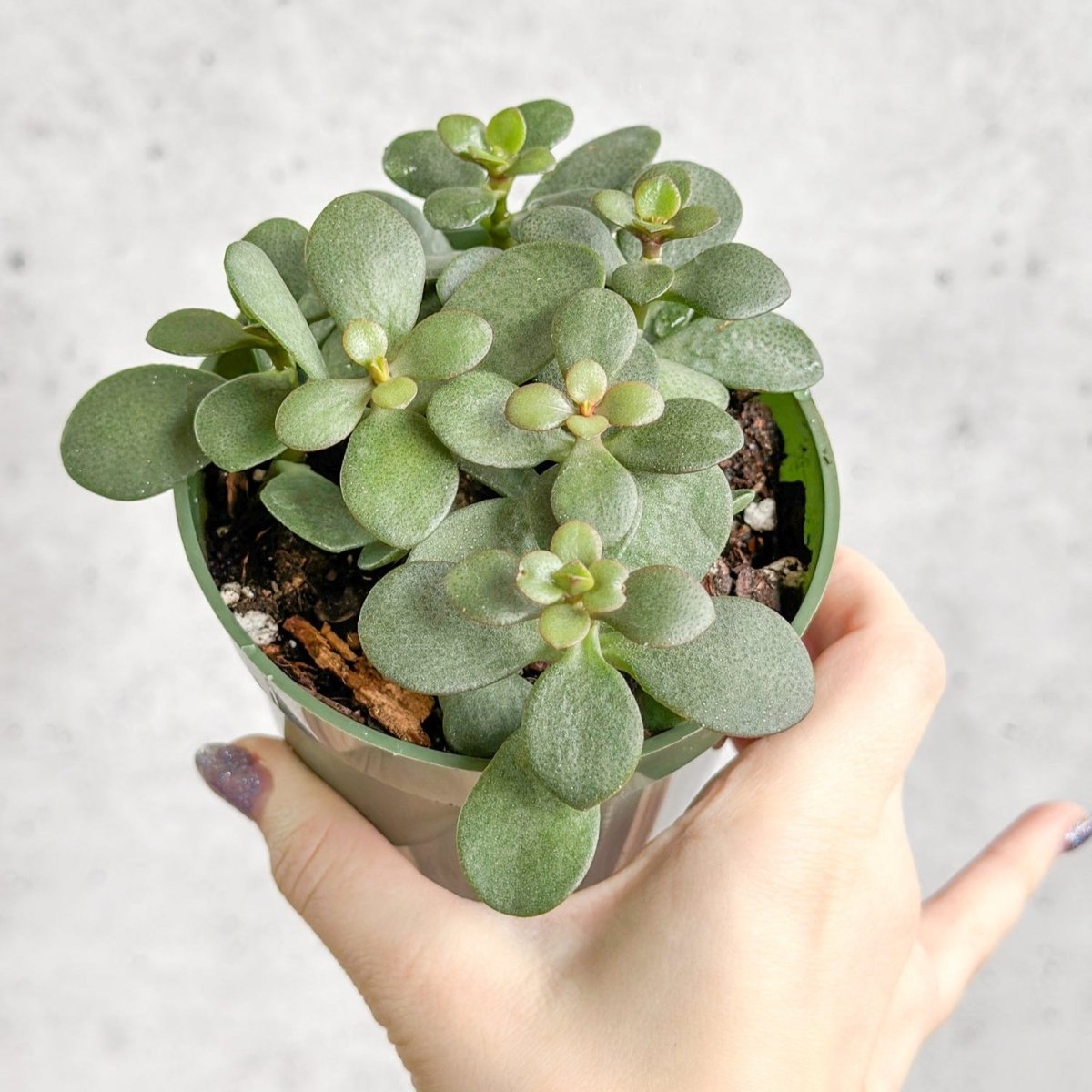
money succulent Jade Plant (Crassula ovata) – Easy-Care Money Succulent

Sale price$22.44 Regular price$24.93
Save 10%

Pay in installments of $6.23 with ShopPay, AfterPay and Klarna

Shipping Estimate
USA
  • USA
  • CAN

Ships within 48 hours · Estimated delivery Aug 25 - Aug 30

Promo Codes Available:

For Your Every Summer RSVP, with Code: SUMMER15

Description

money succulent Jade Plant (Crassula ovata) – Easy-Care Money SucculentProsperity in a Pot: The Resilient Jade Plant Crassula ovata (syn. Crassula argentea), known as the Jade Plant or Money Plant, features thick, glossy, water storing leaves that exude architectural elegance. Under bright light, its margins flush with pink to red, adding seasonal flair. Exceptionally drought tolerant and low maintenance, it brings longevity and positive energy to any indoor setting. Plant Profile Botanical Name: Crassula ovata (syn.

Prosperity in a Pot: The Resilient Jade Plant

Crassula ovata (syn. Crassula argentea), known as the Jade Plant or Money Plant, features thick, glossy, water-storing leaves that exude architectural elegance. Under bright light, its margins flush with pink to red, adding seasonal flair. Exceptionally drought-tolerant and low-maintenance, it brings longevity and positive energy to any indoor setting.


Plant Profile

  • Botanical Name: Crassula ovata (syn. Crassula argentea)
  • Common Names: Jade Plant, Money Plant, Friendship Tree
  • Family: Crassulaceae
  • Native Range: South Africa & Mozambique
  • Mature Size: Up to 3 ft tall & wide indoors; easily pruned for compact displays

Care & Cultivation

  • Light: Full sun to bright, indirect light; 4–6 hrs of direct sun encourages rosy leaf edges.
  • Water: Water thoroughly when soil is completely dry; ensure excellent drainage to prevent root rot.
  • Soil: Use a well-draining cactus/succulent mix or amend potting soil with perlite.
  • Temperature: 65–75 °F (18–24 °C); tolerates down to 45 °F (7 °C) but not frost.
  • Humidity: Low to moderate; average home humidity suffices.
  • Fertilizer: Apply a balanced, diluted fertilizer (10-10-10 NPK) monthly during spring and summer.
  • Pruning: Trim leggy stems to promote branching; remove spent leaves to maintain form.
  • Propagation: Leaf or stem cuttings root in 2–4 weeks in a dry, well-draining medium.
  • Pests: Monitor for mealybugs, scale, and spider mites; treat early with neem oil or insecticidal soap.
  • Toxicity: Mildly toxic if ingested; keep out of reach of pets and children.

Why You’ll Love It

Jade Plants symbolize prosperity and friendship—ideal for gifting or as a focal accent. Their sculptural branching and glossy foliage enhance both minimalist and eclectic interiors.


Fun Fact

Jade Plants can live for decades and develop a thick, bonsai-like trunk, making them living heirlooms and conversation pieces.


History

Native to the dry regions of southern Africa, Jade Plants were collected by European explorers in the 18th century. In Asia, they quickly became tokens of wealth and good fortune, often displayed in homes and businesses.


Ready to Invite Prosperity?

Add Jade Plant to Your Cart →

Shipping Notes
  • Free Standard Shipping on $100+ Orders to the USA.
  • Except Preorder products are shipped in 48 hours.
  • Delivery to the USA:
  1. Standard Shipping : 3-10 business days
  • If time is of the essence, please consider selecting expedited delivery for faster service.
Exchange/Return Notes
  • We offer a 30-day return/exchange service after receiving.
  • Final sale items are not eligible for returns or exchanges.
  • To process your return/exchange, please contact us at [email protected]
  • Please click here for more details>>> Return & Exchange Policy
SKU: 13825316036

Discover Niche Categories That Outsell money succulent

Top-Converting Item to Boost Your Average Order

4.1 ★★★★★
Based on 12 reviews
Sort
Highest Rating
Newest First
Oldest First
Product Reviews
T
Verified Purchase
Tameka Hanford
Alexandria, US
★★★★★ 5
Academic / Thought-Provoking
Format: Paperback
They Were Her Property: White Women as Slave Owners in the American South is a powerful, eye-opening work that challenges long-held assumptions about slavery and gender in American history. Stephanie E. Jones-Rogers thoroughly dismantles the myth that white women were passive or marginal participants in the institution of slavery. Through meticulous research and extensive use of primary sources, including legal records, letters, and testimonies from formerly enslaved people—the book reveals that many white women were active, knowledgeable, and often brutal slave owners in their own right. What makes this book especially compelling is how it centers the voices and experiences of enslaved people to expose the economic, legal, and physical power white women wielded. Jones-Rogers shows that white women not only benefited from slavery but also enforced it, defended it, and used it to build wealth and social status. The writing is clear, authoritative, and accessible, making complex historical arguments understandable without oversimplifying them. This book is an essential read for anyone studying American history, slavery, race, or gender. It forces readers to confront uncomfortable truths and rethink narratives that have long softened or excused the role of white women in slavery. They Were Her Property is both academically rigorous and deeply impactful—a necessary contribution to honest historical understanding.
WAS THIS REVIEW HELPFUL?YesReportShare
Reviewed in the United States on December 16, 2025
E
Verified Purchase
Eric Hobart
Dallas, US
★★★★★ 5
Remarkable analysis of slaveholding women in Antebellum America
Format: Paperback
Stephanie Jones-Rogers has provided us with a book that looks at the South's "peculiar institution" through a very different lens - the slaveholders/slaveowners, but this analysis looks at women that owned slaves, thus opening up a new avenue of study that I hadn't previously seen. Jones-Rogers offers a well written account that is rich in historical details. She demonstrates through vivid historical evidence that the women that owned enslaved people were primarily driven by economic motives, and that these women were just as demanding and could be just as harsh as the "typical" slaveowner image that has been crafted over the years. The book is organized thematically, and each chapter demonstrates the economic motivation behind slave ownership. The reader is offered views of everything from young children becoming slave owners when their parents "gifted" them an enslaved person, and how these young girls were taught that this was "property" that could be used as desired to how these female slaveholders would sell their slaves to meet their economic goals. All told, this is a fascinating book that uncovers a long ignored slice of Antebellum American history that makes the historiographical literature of pre-Civil War history much richer.
WAS THIS REVIEW HELPFUL?YesReportShare
Reviewed in the United States on June 4, 2021
B
Verified Purchase
Becca
Waukegan, US
★★★★★ 5
Poignant, truthful look at women as powerful, business-savvy, yet brutal slave owners
Format: Paperback
Women slave owners were the norm in the South, not the exception. They increased in numbers, stature, and power while the men were off fighting the Civil War. Women often owned the slaves, not the men and knew how to sign prenuptial agreements back then to insure they kept all their property (including slaves) upon divorce or death of their spouse. They traded and bought and sold slaves with business savvy that most men envied. And they could be just as brutal towards their slaves. Ironically, it was the ownership of other people that empowered these women to not be bound to their husbands.
WAS THIS REVIEW HELPFUL?YesReportShare
Reviewed in the United States on January 26, 2025
B
Verified Purchase
Brown David
Alexandria, US
★★★★★ 4
Good history, but not fun, engaging in popular literature.
Format: Paperback
The author is a very competent historian, and proves her points. She does so by stating each thesis and then reciting an exceedingly long string of supporting examples. Rinse and repeat. This is high quality, academic style history, but it’s not very engaging as popular literature. No one’s going to say “I couldn’t put it down.” That being said - I liked it! I learned a lot. Thanks.
WAS THIS REVIEW HELPFUL?YesReportShare
Reviewed in the United States on March 1, 2023
T
Verified Purchase
Tsukiko Brown
Pawtucket, US
★★★★★ 5
Should be required
Format: Paperback
In my opinion, this book should be required reading in high school/college history classes. It’s so important to learn accurate history when it comes to slavery and this book does that. White women played a larger role than we are taught. Please give this a read!
WAS THIS REVIEW HELPFUL?YesReportShare
Reviewed in the United States on October 23, 2025

recommand products